📚 Exam by Category
▾
Objective Questions

Latest Population Studies Exam Question (Objective Questions), MCQ in English

Subjects : Population Studies

Question Bank Population Studies - English
Back to Exam

Population Studies

Question 1Single Answer
Who among the following argued that multiple centres of nuclei were responsible for urban growth ?
  1. A
    Harris and Ullman
  2. B
    Homer Hoyt
  3. C
    Park and Burgess 
  4. D
    Nelson
Question 2Single Answer
In which year, the National Sample Survey (NSS) was set up ?
  1. A
    1950
  2. B
    1960
  3. C
    1970 
  4. D
    1980
Question 3Single Answer
According to 2011 census, which Union Territory of India has lowest literacy rate ?
  1. A
    Chandigarh
  2. B
    Puducherry
  3. C
    Andaman & Nicobar Islands
  4. D
    Dadra & Nagar Haveli
Question 4Single Answer
During which period, India entered into the fourth phase of high population growth ?
  1. A
    1891-1921
  2. B
    1921-1951
  3. C
    1951-1981 
  4. D
    1981-2011
Question 5Single Answer
Which one of the following is used to calculate the rate of natural increase in human population ?
  1. A
    CBR - CDR
  2. B
    CDR + CBR
  3. C
    CDR - CBR 
  4. D
    CBR + CMR
Question 6Single Answer
Which year is called the ‘demographic divide’ in India ?
  1. A
    1881
  2. B
    1901
  3. C
    1921 
  4. D
    1951
Question 7Single Answer
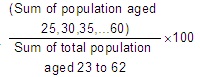
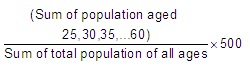
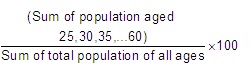
Which among the following is correct formula for Whipple’s Index ?
  1. A
  2. B
  3. C
  4. D
Question 8Single Answer
What is the annual permissible concentration of PM 2.5 in the air, according to World Health Organisation (WHO) ?
  1. A
    60 ug/m3
  2. B
    50 ug/m3
  3. C
    10 ug/m3 
  4. D
    30 ug/m3
Question 9Single Answer
The growth rate of population in India during 2001-2011 was :
  1. A
    14.9 %
  2. B
    15.5 %
  3. C
    17.7 % 
  4. D
    21.2 %
Question 10Single Answer
Which one of the following census can be considered the first modern census in the world ?
  1. A
    Swedish census
  2. B
    British census
  3. C
    Indian census
  4. D
    South African census
Question 11Single Answer
The density of population of India in Census 2011 is :
  1. A
    371
  2. B
    382
  3. C
    390 
  4. D
    401
Question 12Single Answer
Who has introduced the hypothesis of intervening opportunities in migration studies ?
  1. A
    Wilbur Zelinski
  2. B
    K Zipf
  3. C
    Corrado Ginni
  4. D
    Samuel Stauffer
Question 13Single Answer
The estimated Whipple’s Index value 120 indicates that age data is :
  1. A
    Highly accurate
  2. B
    Moderate
  3. C
    Not accurate
  4. D
    Highly inaccurate
Question 14Single Answer
According to causes of death statistics, 2010-13, which one of the following is the leading (highest) cause of death among rural females population in India ?
  1. A
    Respiratory diseases
  2. B
    Cardiovascular diseases
  3. C
    Respiratory infections
  4. D
    Tuberculosis
Question 15Single Answer
Which among the following states in India, urbanisation percentage is the highest, according to 2011 census ?
  1. A
    Tamil Nadu
  2. B
    Maharashtra
  3. C
    Gujarat
  4. D
    Kerala
Question 16Single Answer
Which state has the highest percentage of Christians in India, as per 2011 census ?
  1. A
    Goa
  2. B
    Manipur
  3. C
    Meghalaya 
  4. D
    Nagaland
Question 17Single Answer
Which one is not true when the base of population pyramid is shrinking ?
  1. A
    Increase of logetivity in population
  2. B
    High population growth
  3. C
    Decrease in dependency ratio
  4. D
    Declining fertility
Question 18Single Answer
Which was the Mascot of Indian Census 2011?
  1. A
    A teddy bear
  2. B
    A woman enumerator
  3. C
    A child and mother
  4. D
    A helping hand symbol
Question 19Single Answer
Which of the following are major principles of smart city growth?
(a) Uniform land uses
(b) Range of transport choices
(c) Preserve open space, farmland, natural beauty
(d) Compact building design
(e) Encourage community collaboration in decision-making
Choose the correct answer from the options given below :
  1. A
    (a), (b), (d) only
  2. B
    (a), (d), (e) only
  3. C
    (b), (c), (d), (e) only
  4. D
    (a), (b), (c), (d), (e) only
Question 20Single Answer
The tendency of population to grow after achieving the replacement level of fertility is known as :
  1. A
    Population explosion
  2. B
    Population momentum
  3. C
    Population structure
  4. D
    Population stabilization
Question 21Single Answer
Which of the following is one of the indicator used to compute ‘Human Development Index’?
  1. A
    Infant mortality rate
  2. B
    Morbidity rate
  3. C
    Life expectancy at birth
  4. D
    Death rate
Question 22Single Answer
A country with a constant growth rate of 2.36 per cent, approximately. How many years it will take to double its population?
  1. A
    27 years
  2. B
    30 years
  3. C
    33 years
  4. D
    36 years
Question 23Single Answer
What is straddling birth interval ?
  1. A
    The period between two live births
  2. B
    The period elapsed since the last live birth till survey date
  3. C
    The closed birth interval which includes the survey date and ends after this date in future
  4. D
    The period from the survey date to the date of next birth
Question 24Single Answer
What kind of settlement pattern will be developed when built up area is less compact ?
  1. A
    Clustered
  2. B
    Dispersed
  3. C
    Semi-clustered
  4. D
    Hamleted
Question 25Single Answer
Which is the state with highest population of scheduled tribes in India, as per 2011 Census ?
  1. A
    Gujarat
  2. B
    Madhya Pradesh
  3. C
    Maharashtra 
  4. D
    Odisha
Question 26Single Answer
In which of the following year, Compre­hensive National Nutrition Survey (CNNS) was conducted ?
  1. A
    2015-16
  2. B
    2016-17
  3. C
    2016-18
  4. D
    2017-19
Question 27Single Answer
Which of the following migration theory postulates that migration is a natural outgrowth of disruptions and dislocations that inevitably occur in the process of capitalist development ?
  1. A
    Dual Labour Market Theory
  2. B
    Neoclassical Economics Approach
  3. C
    World System Theory
  4. D
    Network Theory
Question 28Single Answer
Which one of the following is a cohort measure of fertility ?
  1. A
    Gross Reproduction Rate
  2. B
    Net Reproduction Rate
  3. C
    Children Ever Born
  4. D
    General Fertility Rate
Question 29Single Answer
Who among the following postulated the “Threshold Hypothesis” to explain fertility transition ?
  1. A
    Gosta Carlsson
  2. B
    Kingsley Davis
  3. C
    John Bongaarts
  4. D
    The United Nations
Question 30Single Answer
Which of the following state has negative population growth, as per 2011 census ?
  1. A
    Kerala
  2. B
    Nagaland
  3. C
    Goa
  4. D
    Tamil Nadu
Question 31Single Answer
In a life table, Tx represents total number of years lived beyond age x and is symbolically written as :
  1. A
    Tx = Tx + l + Lx
  2. B
    Tx = Lx + l + Lx
  3. C
    Tx = Tx – l + Lx
  4. D
    Tx = Lx – l + Lx
Question 32Single Answer
Which one of the following index is used to measure the extent of preference for age ending with digit ‘0’ and ‘5’ ?
  1. A
    Bogue’s Index
  2. B
    Myer’s Index
  3. C
    UN Age-Sex Accuracy Index
  4. D
    Whipple’s Index
Question 33Single Answer
According to causes of death statistics 2010-13, in India, ten leading causes of death accounts for almost :
  1. A
    70%
  2. B
    74 %
  3. C
    78% 
  4. D
    84%
Question 34Single Answer
Who proposed ‘Intermediate Variables Framework’ in the field of fertility ?
  1. A
    Bongaarts
  2. B
    Coale and Hover 
  3. C
    Davis and Blake 
  4. D
    Caldwell
Question 35Single Answer
For which combination of diseases specific public programme strategies are implemented by the Government ?
  1. A
    Malaria and Dengue
  2. B
    Cancer and Cardiovascular Disease
  3. C
    TB and HIV
  4. D
    STI and HIV
Question 36Single Answer
Which one of the following is not a measure of association for cohort studies ?
  1. A
    Rate ratio
  2. B
    Attributable risk
  3. C
    Odds ratio
  4. D
    Population attributable risk
Question 37Single Answer
Which among the following Union Territory has the lowest population growth rate during 
2001-11 census ?
  1. A
    Lakshadweep
  2. B
    Andaman & Nicobar
  3. C
    Delhi
  4. D
    Chandigarh
Question 38Single Answer
Which one of the following country has the highest Total Fertility Rate (TFR) in the world, as per the World Population Data 2018 (Population Reference Bureau) ?
  1. A
    Gambia
  2. B
    Somalia
  3. C
    Chad D. Niger
  4. D
    Niger
Question 39Single Answer
Which one of the following is part of 'factors affecting exposure to conception’ according to the Davis and Blake Framework, 1956 ?
  1. A
    Age at marriage
  2. B
    Use of Contraception
  3. C
    Voluntary Abstinence
  4. D
    Faetal Mortality
Question 40Single Answer
Who among the following applied micro- economic theory and postulated trade-off between ‘Quantity and Quality’ of children to explain fertility decline?
  1. A
    Richard Easterlin
  2. B
    Gary Becker
  3. C
    Harvey Leibenstein
  4. D
    J.C. Caldwell
Question 41Single Answer
According to causes of death statistics in India, which one of the following represents prematurity and low birth weight causes of death (for both male and female) in ages below 29 days in 2010-2013 ?
  1. A
    47.0%
  2. B
    49.5%
  3. C
    48.1% 
  4. D
    49.0%
Question 42Single Answer
Which one of the following statement is true as per Census of India, 2011 ?
  1. A
    Population enumeration in snow-bound areas occurred during 9 to 28 February, 2011.
  2. B
    Total number of enumerated households were 240 million
  3. C
    National population Register in coastal areas occurred in January, 2011
  4. D
    Total enumeration blocks completed were 3.47 million.
Question 43Single Answer
Which of the following organisation is responsible for official population projection in India ?
  1. A
    Central Statistical Organisation
  2. B
    Registrar General of India
  3. C
    National Sample Survey Organisation
  4. D
    NITI Ayog
Question 44Single Answer
Which one is not a qualitative technique of data collection ?
  1. A
    Household interview
  2. B
    Indepth interview of key Informants
  3. C
    Focus group discussion
  4. D
    Observation
Question 45Single Answer
Following sets of prescriptions were advanced by Malthus to possibly restrict population growth.
(a) Means of subsistence
(b) Positive checks
(c) Birth spacing
(d) Preventive checks
Choose the most appropriate answer from the options given below :
  1. A
    (a), (c), (d) only
  2. B
    (a), (b), (c) only
  3. C
    (a), (b), (d) only 
  4. D
    (b), (c), (d) only
Question 46Single Answer
Which of the following questions were used to measure migration in the Census of India, 2011?
(a) Birth Place
(b) Place of residence at a fixed prior date
(c) Duration of stay since migration
(d) Reason of migration
Choose the correct answer from the options given below :
  1. A
    (a), (b), (c) only
  2. B
    (a), (c), (d) only
  3. C
    (b), (c), (d) only
  4. D
    (a), (b), (d) only
Question 47Single Answer
Which of the following are addressed through spatial statistical analysis?
(a) Time series analysis
(b) Spatial Autocorrelation
(c) Modifiable areal unit problem
(d) Boundary problem
(e) Spatial sampling procedure
Choose the correct answer from the options given below :
  1. A
    (a), (b), (c), (d), (e) only
  2. B
    (b), (c), (d), (e) only
  3. C
    (a), (b), (c), (d) only
  4. D
    (a), (b), (c), (e) only
Question 48Single Answer
Which of the following are part of the Burgess s Concentric Zone model of urban land use ?
(a) Zone of stagnation
(b) Central Business district
(c) Zone in transition
(d) Better residences
(e) Commuter Belt
Choose the correct answer from the options given below :
  1. A
    (a), (b), (c) only
  2. B
    (b), (c), (d), (e) only
  3. C
    (a), (c), (d), (e) only
  4. D
    (a), (b), (c), (d) only
Question 49Single Answer
Health and Wellness Centers envisaged to deliver which of the following services?
(a) MCH care
(b) Care for NCDs
(c) Palliative and Rehablitation care
(d) Mental health care
(e) Chronic communicable diseases’s care Choose the correct answer from the options given below :
  1. A
    (a) and (b) only
  2. B
    (a), (b) and (c) only
  3. C
    (a), (b), (c) and (d) only
  4. D
    (a), (b), (c), (d) and (e) only
Question 50Single Answer
According to SRS bulletin of May 2019, arrange the following states in descending order (high to low), by their level of infant mortality for the year 2017.
(a) Madhya Pradesh 
(b) Rajasthan
(c) Odisha
(d) Telangana
Choose the most appropriate answer from the options given below :
  1. A
    (a), (b), (c), (d) only
  2. B
    (b), (a), (c), (d) only
  3. C
    (a), (c), (b), (d) only
  4. D
    (d), (c), (b), (a) only
Important Questions Package

Population Studies Exam Online Question Bank Package

Buy Population Studies Important Questions, MCQ, question answer in Hindi & English. It will help you to score high marks in Population Studies question bank 2026 in Online, PDF & Print study material.

+ Free Monthly Current Affairs, GK & more PDF Download
Sr.Package NameAmount
1.Population Studies - English
Description : 1000 Question with Answer.
₹101 [₹500]
2.Population Studies - English
Description : 1500 Question with Answer.
₹131 [₹500]
Back to Exam