What is/are the objective/s of Human Resource Management.
A
To bring about maximum individual development of members of the organization by providing opportunities for training and advancement
B
To secure the integration of all the individuals and groups with the organisation by reconciling individual/group goals with those of an organisation.
C
To develop and maintain a quality of work
D
All of the above
Question 2Single Answer
Which of the following is not a semantic barrier of communication ?
A
Faulty translation
B
Ambiguous words
C
Specialist ‘s language
D
Inattention
Question 3Single Answer
HRM is essential for -
A
Dividing the tasks properly with clear-cut authority responsibility and relationship from one position to another.
B
Maintaining sound industrial and human relations so as to secure the willing co-operation.
C
Providing suitable monetary and non-monetary rewards for the contributions of employees
D
All of the above
Question 4Single Answer
The classical theorists favoured organisation based on:
A
Civilian model
B
Strategic model
C
Military model
D
None of the above
Question 5Single Answer
HRM contributes to professional growth by -
A
Providing maximum opportunities for personal development of each employee
B
Maintaining healthy relationship between individuals and different work groups
C
Allocating work properly
D
All of the above
Question 6Single Answer
Performance appraisal by all the following parties is called 360º Performance appraisal :
A
Supervisors and peers
B
Subordinates and employees themselves
C
Users of Service and Consultants
D
All of the above
Question 7Single Answer
The two area of HRM planning involves -
A
Deciding personnel goals
B
Formulating personnel policies and programmes
C
Preparing the human resource budget
D
All of the above
Question 8Single Answer
Fish bone analysis as a tool of quality circle was advanced by:
A
Edward Deming
B
Joseph juran
C
KouruIshiKawa
D
Phillip Crosby
Question 9Single Answer
Controlling the management of human resources involves -
A
Auditing traninig programmes
B
Analysing labour turnover records
C
Directing morale surveys
D
All of the above
Question 10Single Answer
Which of the following decrease group cohesiveness?
A
A agreement on group goals
B
Frequency of interaction
C
Large group size
D
All of the above
Question 11Single Answer
The scope of HRM is very wide. It covers.......aspects.
A
Labour
B
Welfare
C
Industrial Relations
D
All of the above
Question 12Single Answer
According to Fielder‘s Contingency Model of Leadership, which one of the following is a situation variable?
A
Leader – Member relationship
B
Organisational system
C
Degree of task structure
D
Leader’s position power
Question 13Single Answer
A manager who is authorized to direct the work of subordinates and responsible for accomplishing the organization's tasks, is known as -
A
Staff Manager
B
Line Manager
C
Line Authority
D
Implied Authority
Question 14Single Answer
Which of the following is not a traditional method of organizational development ?
A
Survey feedback
B
Sensitivity training
C
Process consulation
D
Managerial grid
Question 15Single Answer
.......... is a set of quantitative performance measures to assess the operations of HR Managers.
A
Metric
B
HR scorecard
C
Employee advocacy
D
Outsourcing
Question 16Single Answer
Who are not the Actors of Industrial Relations?
A
Workers and their organisations
B
Employees and their organisations
C
Community associations
D
Government and the role of the state
Question 17Single Answer
The scope of HRM consists of -
A
Setting general and specific management policy for organization relationship
B
Establishing and maintaining a suitable organisation for leadership and co-operation
C
Collective bargaining, contract negotiation, contract administration and grievance handling
D
All of the above
Question 18Single Answer
A union may claim recognition for an industry in a local area , if it has membership of:
A
10% of the workers in that industry
B
15% of the workers in that area.
C
25% of the workers of that industry in that area.
D
30% of the workers in similar industry
Question 19Single Answer
As a specialist, the HRM department advises all other departments in areas relating to -
A
The management of human resources
B
Industrial relations
C
Both A and B
D
None of these
Question 20Single Answer
Under ESI Act, 1948 a member of the Corporation , standing Committee or the Medical council shall cease to be a member of the body if he fails to attend:
A
Two consecutive meetings
B
Three meetings intermittently
C
Three consecutive meetings
D
Four consecutive meetings
Question 21Single Answer
In a clerical role a HRM manager keeps records of -
A
Time
B
Pay
C
Incentives and performance
D
All of the above
Question 22Single Answer
What is the content of the Schedule I of result in Act, 1948?
A
List of injuries deemed to result in permanent total disablement.
B
List of injuries deemed to result in permanent partial disablement.
C
List of occupational diseases.
D
None of the above
Question 23Single Answer
Specific Personnel Policies relate to -
A
Staffing
B
Compensation
C
Collective Bargaining
D
All of the above
Question 24Single Answer
The registered trade union can collect political fund from its members as a:
A
General fund
B
Cannot collect political fund
C
Separate fund form the interested members
D
Only from political parties
Question 25Single Answer
Personnel policies established by companies regarding employment, includes -
A
Minimum hiring qualifications
B
Preferred sources of recruitment
C
Reservation of seals for scheduled castes & scheduled tribes
D
All of the above
Question 26Single Answer
The ceiling on wage or salary for calculation of Bonus under the payment of bonus Act 1965 is:
A
2500
B
3500
C
4500
D
6500
Question 27Single Answer
HRM attracts and retains the required talent through -
A
Effective human resource planning
B
Recruitment
C
Selection
D
All of the above
Question 28Single Answer
Assertion (A) : Labour Welfare is relative to time and space.
Reason (R) : It shall be universal and perpetual.
A
Assertion and reason are right
B
Assertion is wrong and Reason is right
C
Both Assertion and Reason are wrong
D
Assertion is right but its explanation given in Reason is wrong.
Question 29Single Answer
HRM helps to enhance the dignity of labour by -
1. Providing suitable employment that provides social and psychological satisfaction to people
2. Maintaining a balance between the jobs available in terms of numbers, qualification needs and aptitudes
3. Eliminating waste of human resources through conservation of physical and mental health
A
1 and 2
B
1, 2 and 3
C
2 and 3
D
1 and 3
Question 30Single Answer
Which of the following is not a principle of Labour Welfare?
A
The principle of Uniformity
B
The principle of co- ordination and Integration
C
The principle of Timeliness
D
The principle of Association
Question 31Single Answer
........... is the framework through which management directs, controls and coordinates the efforts of people.
A
Planning
B
Organising
C
Directing
D
Controlling
Question 32Single Answer
‘Labour is not a commodity ‘’- is the assertion made by:
A
The Declaration of Philadelphia adopted by 26th session of ILO
B
The Manga Carta
C
The Constitution of india
D
The International Labour Conference
Question 33Single Answer
.............. is the process of reconciling two goals of the organisation with those of its members.
A
Integration function of HRM
B
The compensation function of HRM
C
The maintenance function of HRM
D
The procurement function
Question 34Single Answer
Assertion (A): Industrial Labour in India has been migratory.
Reason (R): Driving force in migration comes almost entirely form one end of the channel, that is the village end.
A
Both (A) and (R) are wrong
B
(A) is wrong and (R) is right.
C
(A) is right and (R) also is right
D
(A) is right and (R) is wrong
Question 35Single Answer
.............. means assigning suitable jobs to the selected candidates so as to match employee's qualifications with job requirement.
A
Recruitment
B
Selection
C
Placement
D
Orientation
Question 36Single Answer
The “ Marginal Discount Product of Labour” as a modified version of Marginal Productivity Theory was advance by:
A
Taussig
B
Kalecki
C
Ricardo
D
Adam smith
Question 37Single Answer
What is/are the responsibility / responsibilities of line manager?
A
Placing the right person on the right job
B
Training & development of employees
C
Imporving the job performance
D
All of the above
Question 38Single Answer
Which principle of management is violated by matrix organisation structure?
A
Division of Labour
B
Unity of direction
C
Unity of command
D
None of the above
Question 39Single Answer
HRM Department renders secretarial and executive support services like
A
Securing and scrutinising applications
B
Conducting tests and interviews
C
Arranging orientation and training
D
All of the above
Question 40Single Answer
An enquiry that is conduced afresh because of the objections raised by alleged employees is called:
A
Domestic enquiry
B
De- novo enquiry
C
Ex- parte enquiry
D
None of the above
Question 41Single Answer
An organisation accepts imposed personnel policies due to -
A
Pressure of Government
B
Pressure of Trade Union
C
Pressure of Trade Association
D
All of the above
Question 42Single Answer
The concept of HRD scorecard was introduced in India by:
A
Udai Pareek
B
Rao and Pareek
C
T.V. Rao
D
Arun Honappa
Question 43Single Answer
......... measures the HR function's effectiveness and efficiency in producing employees ' behaviour needed to achieve the company's strategic goals.
A
HR scorecard
B
Metrics
C
Employee advocacy
D
Line authority
Question 44Single Answer
Which of the following trends is the employment relations in the economic era not correct?
A
Declining stability and security
B
Declining labour intensity
C
No shift form contract of service to contract of service
D
Declining mutual commitment
Question 45Single Answer
A manager can tap the maximum potential of employees through -
A
Proper Planning
B
Proper organisation structure
C
Proper direction
D
Proper controlling
Question 46Single Answer
Human Resource Management seeks to -
A
Attain economically and effectively the organisation goals
B
Serve to the highest possible degree the individual goals
C
Preserve and promote the general welfare of the community.
D
All of the above
Question 47Single Answer
............. is the company's long-term plan for how it will balance its internal strengths and weaknesses with its external opportunities and threats to maintain a competitive advantage.
A
Strategy
B
Strategic plan
C
Strategic management
D
Strategic control
Question 48Single Answer
Which of the following principles of management was not given by Fayol?
A
Unity of direction
B
Subordination of individual interest to common interest
C
Stability of tenure
D
Standardisation
Question 49Single Answer
Personnel policies established by companies regarding industrial relations, include -
A
Handling of grievance
B
Recognition of trade union
C
Discipline and conduct rules
D
All of the above
Question 50Single Answer
Delphi technique is used in:
A
Organising
B
Operating
C
Staffing
D
Forecasting
Important Questions Package
PGCIL Assistant Officer Trainee Exam Online Question Bank Package
Buy PGCIL Assistant Officer Trainee Important Questions, MCQ, question answer in Hindi & English. It will help you to score high marks in PGCIL Assistant Officer Trainee question bank 2026 in Online, PDF & Print study material.
+ Free Monthly Current Affairs, GK & more PDF Download
Sr.
Package Name
Amount
1.
PGCIL Assistant Officer Trainee Exam - English
Description : 1000 Question with Answer
₹101[₹500]
2.
PGCIL Assistant Officer Trainee Exam - English
Description : 1500 Question with Answer
₹131[₹500]
3.
PGCIL Assistant Officer Trainee Exam Question Bank Book - English
Description : 1000 Question with Answer (Printed Material)
₹390[₹600]
HR
Question 51Single Answer
Manpower planning involves -
A
The study of the manpower environment
B
The study of manpower utilisation
C
Both A and B
D
None of these
Question 52Single Answer
The following concept is developed on unitarism , individual , high commitment and strategic alignment:
A
Personal Management
B
Human Resource Management
C
Industrial Relations
D
Personal Administration
Question 53Single Answer
A man power plan consists of -
A
Demand plan
B
Supply plan
C
Both A and B
D
None of these
Question 54Single Answer
Which one is not a non- quantitative job evaluation method?
A
Ranking method
B
Grading method
C
Point rating method
D
Job- classification method
Question 55Single Answer
Personnel policies established by companies regarding working conditions, include -
A
Working hours
B
Number of duration of rest intetvals
C
Overtime work
D
All of the above
Question 56Single Answer
Who is not associated with development of human development index?
A
Mahabub- ul-Haq
B
Man mohan singh
C
Meghnad Desai
D
Sudhir Anand
Question 57Single Answer
........... is a group of positions involving some duties, responsibilities, knowledge and skills.
A
Job
B
Position
C
Task
D
Duty
Question 58Single Answer
Who introduced the concept of quality circles in India?
A
P.V. Rao
B
UdaiPareek
C
Dharani P. Sinha
D
P.C. Bihari
Question 59Single Answer
........... implies a group of jobs which are similar as to the type of work and which contain common characteristics.
A
Position
B
Occupation
C
Duty
D
Task
Question 60Single Answer
Which of the following is the correct sequence of training evaluation?
A
Reaction , learning , behavior and results
B
Learning , reaction , behavior and results
C
Learning, behavior , reaction and results
D
Reaction, Learning , results and behavior
Question 61Single Answer
.............. is the process of evaluation the employees ' performance of the job in terms of the requirement of the job.
A
Merit rating
B
Job evaluation
C
Job analysis
D
Performance appraisal
Question 62Single Answer
Under Alderfer’s ERG theory , the three core needs are:
A
Emotional , Relations and growth
B
Emotional, Reliability and Growth
C
Existence, Reliability and Gain
D
Existence , Relations and Growth
Question 63Single Answer
Interviews are classified according to -
A
Content
B
Structure
C
Method of administration
D
All of the above
Question 64Single Answer
The group to which a person would like to belong is known as:
A
Primary Group
B
Membership Group
C
Reference Group
D
None of the above
Question 65Single Answer
........... is a method in which trainees learn on the actual or simulated equipment they will use on the job, but are actually trained off the job.
A
Simulated training
B
Job instruction training
C
Programmed learning
D
Negligent training
Question 66Single Answer
Arrange the following stages of group dynamics in right sequence:
(a) Norming
(b) Performing
(c) Strorming
(d) Forming
A
D,C,A,B
B
A,B,C,D
C
D,C,B,A
D
C,D,B,A
Question 67Single Answer
.................. implies shifting of an employee from one job to another without any major change in the status and responsibility of the employee.
A
Transfer
B
Promotion
C
Selection
D
Recruitment
Question 68Single Answer
Which is the order of correct settlement of industrial disputes?
(a) Industrial Tribunal
(b) National Tribunal
(c) Conciliation
(d) Labourcourt
A
C,A,D,B
B
C,D,A,B
C
A,D,C,B
D
C,B,D,A
Question 69Single Answer
What is/are the external source/s of recruitment?
A
Press advertisement
B
Educational institutions
C
Placement agencies
D
All of the above
Question 70Single Answer
The code of discipline was ratified by the Indian Labour Conference to ensure discipline in industry . Identify the year of ratification out of the following:
A
1957
B
1958
C
1942
D
1962
Question 71Single Answer
What is/are the purpose/s of transfers?
A
To meet organisation needs
B
To satisfy employee needs
C
To better utilize employees
D
All of these
Question 72Single Answer
Which is not a structure of trade Union of industrial Organisation?
A
Craft union
B
General union
C
Industrial union
D
Consumers’ union
Question 73Single Answer
Merit based promotion implies -
A
Knowledge
B
Skills
C
Performance record of an employee
D
All of the above
Question 74Single Answer
If there is willful removal or disregard by the workman of any safety guard or other device which he knew to have been provided for the purpose of securing safety of workman:
A
Employer is liable to pay compensation
B
Employer is not liable to pay compensation
C
Appropriate government is liable to pay compensation
D
The trade Union is liable to pay compensation
Question 75Single Answer
What is/are the disadvantage/s of merit based promotion ?
A
It is very difficult to judge merit and subjective judgment is involved
B
Trade union and workers distrust the integrity of management in judging merit
C
Old employees feel insecurity
D
All of the above
Question 76Single Answer
In case of fatal accident if the commissioner serves notice to the employer based on his source
I. The employer can neglect the notice.
II. If the employer thinks liable , he shall make the deposit within sixty days of the service of notice
III. If the employer thinks liable, he shall make the deposit within thirty days of the service of notice.
IV. If the employer is not liable , he shall in his statement indicate the grounds on which he disclaims liability.
A
All statement are correct.
B
All statement are correct.
C
Only(I) and (IV) are correct.
D
Only(III) and (IV) are correct.
Question 77Single Answer
The payment of Bonus Act. , 1965 is applicable to an employee who draws wage or salary of:
A
3500 in case of apprentice
B
5000 in case of apprentice and employee
C
7500 in case of employee only
D
10000, in case of employee only
Question 78Single Answer
Human resource plans can be formulated at -
A
National level
B
Sectoral level
C
Industry and unit level
D
All of the above
Question 79Single Answer
The mountain Wages Act, 1948 has:
A
One schedule covering different types of industries.
B
One schedule covering different types of industries , shops and establishments.
C
One schedule covering shops and establishments .
D
Two schedules covering industrial establishments and agriculture
Question 80Single Answer
............ implies a collection of tasks and duties regularly assigned to one person.
A
Occupation
B
Position
C
Job
D
Job evaluation
Question 81Single Answer
The maximum daily hours of work in a day with normal wage allowed in factories is:
A
11 hours
B
10 hours
C
9 hours
D
8 hours
Question 82Single Answer
............. refers to a distinct work activity with an identifiable beginning end.
A
Duty
B
Task
C
Job
D
Job evaluation
Question 83Single Answer
Who is the champion of the ‘Welfare movement ‘ propagated in mild 19th century?
A
Frederick Winslow Taylor
B
Andrew Ure
C
SheebhomRownlvee
D
Robert Owners
Question 84Single Answer
HRM is regarded as old wine in a new bottle. This idea was formulated by -
A
Armstrong
B
Guest
C
Storey
D
Peter Drucker
Question 85Single Answer
Which of the following statements relating to Welfare Officer is not true:
A
The provision of Welfare Officer is given in both the Factories Act, 1948 and the Mines , 1952
B
Welfare Officer ‘s duties and responsibilities are defined and prescribed in the legislation .
C
Welfare Officer ‘s appointment is tagged to the provision of minimum workforce employed in an organisation
D
The Welfare Officer ‘s role was designed as a’ Third force’.
Question 86Single Answer
A selection test is a sample of some aspects of an individual's -
A
Attitudes
B
Behaviour
C
Performance
D
All of the above
Question 87Single Answer
Which of the following statements about labour market is not true?
A
Labour market like commodity market is analyzed by supply, demand and price equilibrium
B
Labour Market is relatively more local than commodity market.
C
Unlike a commodity market ,the relationship between a buyer and seller in a labour market is not temporary
D
Monopoly in the labour market is high
Question 88Single Answer
............... refers to shifting of an employee to a higher position carrying higher status, responsibilities and pay.
A
Selection
B
Promotion
C
Transfer
D
Recruitment
Question 89Single Answer
Money wage is otherwise called as:
A
Real wage
B
Living wage
C
Nominal wage
D
Fair wage
Question 90Single Answer
............. derermines the skill or knowledge already acquired by a person through training and on the job experience.
A
Achievement or Proficiency Test
B
Personality Test
C
Aptitude Test
D
Interest Test
Question 91Single Answer
Which of the following is not a determinant of wages?
A
Prevailing wages
B
Bargaining strength of Unions
C
Job Evaluation
D
Performance Appraisal
Question 92Single Answer
What is/are the need/s of transfers?
A
To make the employee more versatile
B
To adjust the workforce
C
To punish employees
D
All of the above
Question 93Single Answer
Which of the following is not a characteristics of trade Union?
A
Is an association of employers or the employees of the independent workers?
B
Is relatively a permanent combination but not temporary or causal
C
Is an association of workers who are engaged in not securing economic benefits for their members.
D
Is influenced by a member of ideologies .
Question 94Single Answer
What is/are the disadvantage/s of seniority for the promotions?
A
The assumption that length of service indicates talent is not vaild. Beyound a certain age a person may not learn
B
In this system the performance and potential of an individual is not recognised
C
The concern fails to attract young and hardworking employees
D
All of the above
Question 95Single Answer
Which of the following requirements is related with a good transfer policy?
A
It should be clearly specified the types of transfers and the circumstances
B
It should be prescribed on the basis of transfer
C
It should be indicated the executive responsible for initiating and approving the transfers
D
All of the above
Question 96Single Answer
............are inventories of a candidate's likes and dislikes in relation to work.
A
Altitude Test
B
Achievement Test
C
Personality Tests
D
Interest Test
Question 97Single Answer
Which of the following is the meaning of Human Resource planning?
A
Evaluation of job
B
Satisfaction of the employees on the job
C
Appraising the performance of employees
D
It is process by which an organisation ensures that is has the right number and kind of people at the right place, at the right time
Question 98Single Answer
A good promotion policy should be-
A
Entrusted with the responsibility of taking decision on promotion
B
Fair and impartial arbitrariness, favouritism, etc. Should be eliminated
C
Consistent i.e. it should be applied uniformly irrespective of the person concerned
D
All of the above
Question 99Single Answer
The main difference between delegation and decentralisation are
(a) Delegation involves transfer of authority and not responsibility ;where asdecentralisation involves transfer of authority and responsibility .
(b) Decentralisation is by the will of the superior ; while delegation is done legally.
(c) Distributing authority can task place at will while in decentralisation it requires a legal action.
Select the correct answer using the codes given below:
A
I and 2
B
I and 3
C
2 and 3
D
All of these
Question 100Single Answer
Demotion affects -
A
The status of the employee
B
The career of the employee
C
The income of the employee
D
All of the above
Question 101Single Answer
Which of the following is not a limitation of job Expansion?
A
Higher capital
B
Individual differences
C
Lower wage rates
D
Smaller labour pool
Question 102Single Answer
Demotion should not be used as a penalty for -
A
Poor attendance record
B
Violation of rules of conduct or insubordination
C
Both A and B
D
None of these
Question 103Single Answer
The difference between job enrichment and job enlargement is that:
A
Enlarged jobs include some of the planning and control system whereas enrichment means getting more money for the same job.
B
Enlarged jobs, contain a large number of similar tasks , while enriched jobs, include some of the planning and control in the hands of job holder
C
Enriched jobs include performing number of boring jobs. As well along with the one he is performing
D
All of the above
Question 104Single Answer
............ of an employee takes place when his service agreement with organisation comes to an end and the employee leaves the organisation.
A
Promotion
B
Demotion
C
Separation
D
Selection
Question 105Single Answer
The reliability of any test is assured when a person:
A
Scores differently than others taking the same test
B
Scores the same at two or more different points in time
C
Scores differently at two or more different points in time
D
None of the above
Question 106Single Answer
An employee may resign on grounds of -
A
III - health
B
Marriage
C
Better opportunities in other organisations
D
All of the above
Question 107Single Answer
In every company meeting , agenda is to be submitted . What does it mean by agenda?
A
Statement of business to be transacted in the meeting
B
Statement of business not to be transacted in the meeting
C
Is a statement of business
D
Is a statement of problems to be forwarded to manager
Question 108Single Answer
In ............ an employee may retire before attaining the specified age.
A
Compulsory retirement
B
Premature retirement
C
Voluntary retirement
D
Resignation
Question 109Single Answer
An employee may retire before attaining the specified age due to -
A
Bad health
B
Physical disability
C
Family problems
D
All of the above
Question 110Single Answer
Which of the following is an important feature of” Autonomous Working Group”?
A
The group reports directly to the senior management by passing their immediate bosses
B
The creation of teams which have a high level of autonomy and control over their immediate working environment
C
The bringing together of various individuals who have a common interest in solving certain problems
D
A group of experts brought into research new ways of producing a product
Question 111Single Answer
.............is temporary denial of employment.
A
Retirement
B
Layoff
C
Termination
D
Dismissal
Question 112Single Answer
Structured learning refers to which of the following statement ?
A
Planned and associated with specific objectives
B
Role- learning from the text – books
C
Learning that is imposed due to fear
D
None of the above
Question 113Single Answer
.............. means permanent termination of an employee 's services for economic reasons in a going concern.
A
Retirement
B
Retrenchment
C
Separation
D
Dismissal
Question 114Single Answer
A situation where management is unable to provide employment due to non-availability of work is called:
A
Lock out
B
Lay off
C
Termination
D
Attrition
Question 115Single Answer
Misconduct means willful violation of rules and regulations. It includes -
A
Indiscipline
B
Insubordination
C
Dishonesty
D
All of the above
Question 116Single Answer
Which of the following shows a situation of Trade Union Rivalries in India?
A
Different Unions in different organisation
B
More unions in the same organisation having affiliation with different political Parties and representing the same type of workers
C
More unions in the same organisation all representing different types of workers
D
None of the above
Question 117Single Answer
..............means the failure of a worker to report for work when he is scheduled to work.
A
Absenteeism
B
Attendance
C
Labour turnover
D
Present
Question 118Single Answer
A union meant to protect the interests and rights of the non- manual employees is called a;
A
White collar union
B
Brown collar union
C
Blue collar union
D
None of these
Question 119Single Answer
Employees remain absent due to -
A
Industrial accidents and injuries
B
Lack of interest
C
Poor management system
D
All of the above
Question 120Single Answer
What should be the minimum number of persons required to register a trade union?
A
Six
B
Seven
C
Eight
D
Nine
Executive Aptitude Test
Question 121Single Answer
How many such pairs of letters are there in the word ‘CLEANLINESS’ each of the which has as many letters between them in the word as they have in the English alphabet, in the same sequence?
A
Two
B
Three
C
Five
D
Four
E
None of these
Question 122Single Answer
Team A has scored more goals than Team B
Team C has scored fewer goals than Team B
Team A has scored fewer goals than Team C .
If the first two statements are true, the third statement is
A
True
B
False
C
Uncertain
D
None
Question 123Single Answer
If it is possible to make only one meaningful word with the second, the third, the sixth and the eight letters of the word FRAGMENT using each only once, which of the following will be the third letter of that word ? If no such word can be formed, give ‘X’ as the answer and if more than one such word can be formed, give ‘Y’ as the answer.
A
A
B
E
C
T
D
X
E
Y
Question 124Single Answer
How many such letters are there in the word ORIENTAL each of which is as far away from the beginning of the word as when they are arranged alphabetically?
A
None
B
One
C
Two
D
Three
E
More than three
Question 125Single Answer
How many such pairs of letters in the word CREDIT each of which has as many letters between them in the word as in the English alphabet?
A
None
B
One
C
Two
D
Three
E
More than three
Question 126Single Answer
How many meaningful words can be made from the letters ‘LMEA’ using each letter only once in each word?
A
None
B
One
C
Two
D
Three
E
More than three
Question 127Single Answer
If it is possible to make only one meaningful word with the first, the second, the seventh and the eighth letters of the word TEMPORAL, which of the following will be the first letter of that word? If more than one such word can be made, give ‘Y’ as the answer and if no such word can be made, give ‘X’ as the answer.
A
T
B
L
C
E
D
Y
E
X
Question 128Single Answer
If the letters of the word HANDOVER are arranged alphabetically from left to right how many letters will remain at the same position?
A
None
B
One
C
Two
D
Three
E
More than three
Question 129Single Answer
How many such pairs of letters are there in the word EXCURSION, each of which has as many letters between them in the word as they have in the English alphabet?
A
None
B
One
C
Two
D
Three
E
More than three
Question 130Single Answer
If it is possible to make only one meaningful word with the first, the second, the third, the sixth and the eighth letters of the word DEVIATION first letter of that word is your answer? If more than one such word can be made formed your answer is ‘A’ and if no such word can be formed your answer is ‘B’.
A
V
B
T
C
E
D
A
E
B
Question 131Single Answer
Passage :
A B C D E F G H I J K L M N O P Q R S T U V W X Y Z .
Which letter in this alphabet is the eighth letter to the right of the letter and which is tenth letter to the left of the last but one letter of the alphabet ?
A
X
B
W
C
I
D
H
Question 132Single Answer
Passage :
Direction : The following question is based on the five words given below:
AND FOR THE BIG SUM (The new words formed after performing the mentioned operations may or may not necessarily the meaningful English words.)
If the third alphabet of each of the words is changed to the next alphabet in the English alphabetical series, which of the following will form a meaningful English word?
A
SUM
B
BIG
C
Both BIG and THE
D
FOR
E
Both FOR and BIG
Question 133Single Answer
Passage :
Direction : The following question is based on the five words given below:
AND FOR THE BIG SUM (The new words formed after performing the mentioned operations may or may not necessarily the meaningful English words.)
If the given words are arranged in the order as they would appear in a dictionary from left to right, which of the following will be second from the right ?
A
AND
B
FOR
C
THE
D
BIG
E
SUM
Question 134Single Answer
Passage :
Direction: The following question is based on the five words given below:
AND FOR THE BIG SUM (The new words formed after performing the mentioned operations may or may not necessarily the meaningful English words.)
If second alphabet in each of the words is changed to next alphabet in the English alphabetical order, how many words having two vowels (same or different vowels) will be formed ?
A
None
B
One
C
Two
D
Three
E
Four
Question 135Single Answer
Passage :
Direction : The following question is based on the five words given below:
AND FOR THE BIG SUM (The new words formed after performing the mentioned operations may or may not necessarily the meaningful English words.)
How many letters are there in the English alphabetical series between the second letter of the word which is second from the right and the second letter of the word which is second from the left of the given words?
A
Two
B
Five
C
Six
D
Nine
E
Three
Question 136Single Answer
The cash difference between the selling prices of an article at a profit of 4% and 6% is Rs. 3. The ratio of the two selling prices is:__________ ?
A
51:52
B
52:53
C
51:53
D
52:55
Question 137Single Answer
Which of the following numbers is irrational ?
A
√49
B
0.125
C
√2
D
22/7
Question 138Single Answer
356 x 936 – 356 x 836 = ?
A
35600
B
34500
C
9630
D
93600
Question 139Single Answer
Arrange in descending order: 5/8, 7/10, 3/4
A
3/4 > 7/10 > 5/8
B
7/10 > 3/4 > 5/8
C
3/4 > 5/8 > 7/10
D
5/8 > 7/10 > 3/4
Question 140Single Answer
What is (3^{4} times 9^{2}) ?
A
36
B
38
C
310
D
96
Question 141Single Answer
If 34X-2 = 729, then find the value of X.
A
4
B
3
C
2
D
5
Question 142Single Answer
Convert 0.6 into fraction ?
A
3/5
B
2/3
C
4/5
Question 143Single Answer
The no. plate of a bus had peculiarity. The bus number was a perfect square. It was also a perfect square when the plate numbers were reversed. The bus company had only five hundred buses numbered from 1 to 500. What was the number ?
A
169
B
36
C
196
D
Can not say
Question 144Single Answer
If a and b are positive integers, such that ab = 125, then (a-b)a+b-4 = ?
A
16
B
25
C
28
D
30
Question 145Single Answer
If x*y = x2 + y2 – xy, then value of 9*11 is
A
93
B
103
C
60.5
D
121
Question 146Single Answer
Passage :
information given below and answer the question that follow.
The result of an exam is given below. Out of 1000 students who appeared
(i) 658 failed in Physics
(ii) 166 failed in Physics and Chemistry
(iii) 372 failed in Chemistry, 434 failed in Physics and Maths
(iv) 590 failed in Maths, 126 failed in Maths & Chemistry
Find the number of people who failed in (assuming that none is passed in all subjects.
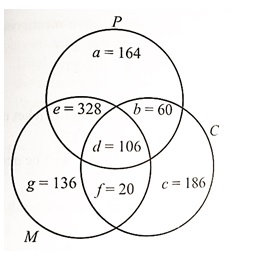
We have the following equations:
a+ b + c + d + e + f + g = 1000
a + b + d + e = 658, b + d = 166
b + d + c + f = 372
d + e = 434 as in the figure.
d + e + f + g = 590, d + f = 126. Find the values
Chemistry but not in Physics.
A
318
B
198
C
213
D
206
Question 147Single Answer
Passage :
Direction: information given below and answer the question that follow.
The result of an exam is given below. Out of 1000 students who appeared
(i) 658 failed in Physics
(ii) 166 failed in Physics and Chemistry
(iii) 372 failed in Chemistry, 434 failed in Physics and Maths
(iv) 590 failed in Maths, 126 failed in Maths & Chemistry
Find the number of people who failed in (assuming that none is passed in all subjects.
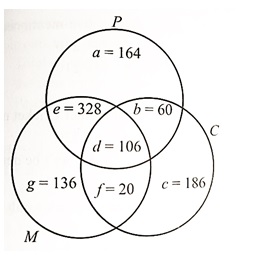
We have the following equations:
a+ b + c + d + e + f + g = 1000
a + b + d + e = 658, b + d = 166
b + d + c + f = 372
d + e = 434 as in the figure.
d + e + f + g = 590, d + f = 126. Find the values
Physics or Maths but not in Chemistry.
A
558
B
718
C
628
D
None of these
Question 148Single Answer
Passage :
For the next four question that follow:
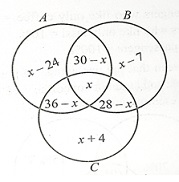
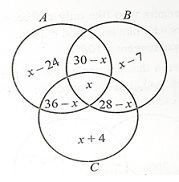
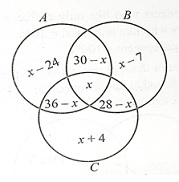
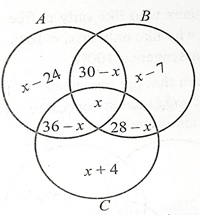
In a city, three daily newspapers A, B, C are published, 42% read A; 51% read B; 68% read C; 30% read A and B; 28% read B and C; 36% read A and C; 8% do not read any of the three newspapers.
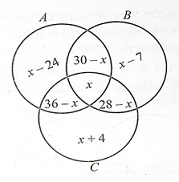
Let x% people read all the three newspapers.
Since 8% people do not read any newspapers.
(x – 24) + (x – 7) + (x + 4) + (30 – x) + (36 – x) + (28 – x) + x = 92
→ x + 98 – 31 = 92
→ x = 92 – 67 = 25
What is the percentage of persons who read all the three papers ?
A
20%
B
25%
C
30%
D
40%
Question 149Single Answer
Passage :
For the next four : question that follow :
In a city, three daily newspapers A, B, C are published, 42% read A; 51% read B; 68% read C; 30% read A and B; 28% read B and C; 36% read A and C; 8% do not read any of the three newspapers.
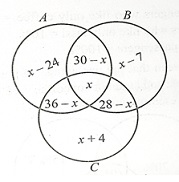
Let x% people read all the three newspapers.
Since 8% people do not read any newspapers.
(x – 24) + (x – 7) + (x + 4) + (30 – x) + (36 – x) + (28 – x) + x = 92
→ x + 98 – 31 = 92
→ x = 92 – 67 = 25
What is the percentage of persons who read only two papers?
A
19%
B
31%
C
44%
D
None of these
Question 150Single Answer
Passage :
For the next four : question that follow :
In a city, three daily newspapers A, B, C are published, 42% read A; 51% read B; 68% read C; 30% read A and B; 28% read B and C; 36% read A and C; 8% do not read any of the three newspapers.
Let x% people read all the three newspapers.
Since 8% people do not read any newspapers.
(x – 24) + (x – 7) + (x + 4) + (30 – x) + (36 – x) + (28 – x) + x = 92
→ x + 98 – 31 = 92
→ x = 92 – 67 = 25
What is the percentage of persons who read only one paper ?
A
38%
B
48%
C
51%
D
None of these
Question 151Single Answer
Passage :
For the next four : question that follow:
In a city, three daily newspapers A, B, C are published, 42% read A; 51% read B; 68% read C; 30% read A and B; 28% read B and C; 36% read A and C; 8% do not read any of the three newspapers.
Let x% people read all the three newspapers.
Since 8% people do not read any newspapers.
(x – 24) + (x – 7) + (x + 4) + (30 – x) + (36 – x) + (28 – x) + x = 92
→ x + 98 – 31 = 92
→ x = 92 – 67 = 25
What is the percentage of persons who read only A but neither B nor C ?
A
4%
B
3%
C
1%
D
None of these
Question 152Single Answer
Passage :
For the next four : question that follow:
In a city, three daily newspapers A, B, C are published, 42% read A; 51% read B; 68% read C; 30% read A and B; 28% read B and C; 36% read A and C; 8% do not read any of the three newspapers.
Let x% people read all the three newspapers.
Since 8% people do not read any newspapers.
(x – 24) + (x – 7) + (x + 4) + (30 – x) + (36 – x) + (28 – x) + x = 92
→ x + 98 – 31 = 92
→ x = 92 – 67 = 25
If A and B are any two sets, then what is A ᴖ (A ᴗ B) equal to ?
A
Complement of A
B
Complement of B
C
B
D
A
Question 153Single Answer
Passage :
For the next four : question that follow:
In a city, three daily newspapers A, B, C are published, 42% read A; 51% read B; 68% read C; 30% read A and B; 28% read B and C; 36% read A and C; 8% do not read any of the three newspapers.
Let x% people read all the three newspapers.
Since 8% people do not read any newspapers.
(x – 24) + (x – 7) + (x + 4) + (30 – x) + (36 – x) + (28 – x) + x = 92
→ x + 98 – 31 = 92
→ x = 92 – 67 = 25
40% of the people read newspaper X, 50% read newspaper Y and 10% read both the papers. What percentage of the people read neither newspaper ?
A
10%
B
15%
C
20%
D
25%
Question 154Single Answer
Passage :
Read the passage below and solve the question based on it.
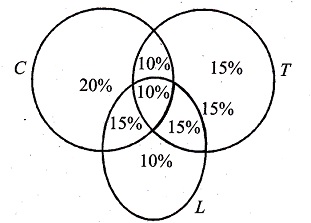
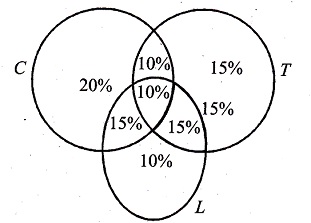
5% of the passengers do not like coffee, tea and lassi and 10% like all the three, 20% like coffee and tea, 25% like lassi and coffee and 25% like lassi and tea. 55% like coffee, 50% like tea, and 50% like lassi.
Where C = Coffee, T = Tea and L =Lassi
The passengers who like only coffee is greater than the passengers who like only lassi by
A
25%
B
100%
C
75%
D
0%
Question 155Single Answer
Passage :
Read the passage below and solve the question based on it.
5% of the passengers do not like coffee, tea and lassi and 10% like all the three, 20% like coffee and tea, 25% like lassi and coffee and 25% like lassi and tea. 55% like coffee, 50% like tea, and 50% like lassi.
Where C = Coffee, T = Tea and L =Lassi
The percentage of passengers who like both tea and lassi but not coffee, is
A
15
B
25
C
40
D
75
Question 156Single Answer
Read sentence to find out whether there is any grammatical error in it. The sentences are In three separate parts and each one is labelled (a), (b), (c) and (d). In that case, letter (d) will signify a ‘No error’ response.
A
He was in the temper
B
and refused
C
discuss the matter again
D
No error
Question 157Single Answer
Read sentence to find out whether there is any grammatical error in it. The sentences are In three separate parts and each one is labelled (a), (b), (c) and (d). In that case, letter (d) will signify a ‘No error’ response.
A
A flower makes no garland
B
so we must do a thing together
C
in a unit for a good result
D
No error
Question 158Single Answer
Read sentence to find out whether there is any grammatical error in it. The sentences are In three separate parts and each one is labelled (a), (b), (c) and (d). In that case, letter (d) will signify a ‘No error’ response.
A
My friend is a software engineer
B
and his wife is doctor
C
so they don’t have enough time for each other
D
No error
Question 159Single Answer
Read sentence to find out whether there is any grammatical error in it. The sentences are In three separate parts and each one is labelled (a), (b), (c) and (d). In that case, letter (d) will signify a ‘No error’ response.
A
I don’t have much time that
B
I hear you in detail with verbosity
C
tell everything in nutshell
D
No error
Question 160Single Answer
Read sentence to find out whether there is any grammatical error in it. The sentences are In three separate parts and each one is labelled (a), (b), (c) and (d). In that case, letter (d) will signify a ‘No error’ response.
A
The atmosphere is changing
B
so I have severe pain in my body
C
if you have any painkiller, please give it to me
D
No error
Question 161Single Answer
Read sentence to find out whether there is any grammatical error in it. The sentences are In three separate parts and each one is labelled (a), (b), (c) and (d). In that case, letter (d) will signify a ‘No error’ response.
A
No one is without fault
B
because no one is God
C
and only God is fault free
D
No error
Question 162Single Answer
Read sentence to find out whether there is any grammatical error in it. The sentences are In three separate parts and each one is labelled (a), (b), (c) and (d). In that case, letter (d) will signify a ‘No error’ response.
A
Your
B
clock is
C
one hour fast
D
No error
Question 163Single Answer
Read sentence to find out whether there is any grammatical error in it. The sentences are In three separate parts and each one is labelled (a), (b), (c) and (d). In that case, letter (d) will signify a ‘No error’ response.
A
The lose of jobs
B
is regarded by some as an necessary evil
C
in the fight against infliation
D
No error
Question 164Single Answer
Read sentence to find out whether there is any grammatical error in it. The sentences are In three separate parts and each one is labelled (a), (b), (c) and (d). In that case, letter (d) will signify a ‘No error’ response.
A
In science, the credit goes to a man
B
who convinces the world
C
not to the man to whom the idea first occurs
D
No error
Question 165Single Answer
Read sentence to find out whether there is any grammatical error in it. The sentences are In three separate parts and each one is labelled (a), (b), (c) and (d). In that case, letter (d) will signify a ‘No error’ response.
A
It is only after
B
the match is over
C
that people realize how exciting it is
D
No error
Question 166Single Answer
Passage :
In the following question, out of the four alternatives, select the alternative which best expresses the meaning of the idiom/phrase.
To sleep with the fishes
A
Always be in a dream world
B
To make absurd excuses
C
To sleep peacefully
D
To be dead
Question 167Single Answer
Passage :
In the following question, out of the four alternatives, select the alternative which best expresses the meaning of the idiom/phrase.
To free someone or something form a constraint or difficulty.
A
To exterminate
B
To expurgate
C
To intricate
D
To extricate
Question 168Single Answer
Passage :
In the following question, out of the four alternatives, select the alternative which best expresses the meaning of the idiom/phrase.
Liquids forming a homogeneous mixture when added together
A
Irascible
B
Crucible
C
Miscible
D
Risible
Question 169Single Answer
Passage :
In the following question, out of the four alternatives, select the alternative which best expresses the meaning of the idiom/phrase.
Shooting fish in a barrel
A
To do random acts of stupidity
B
To behave in a cruel manner
C
Ridiculously easy
D
To escape through a narrow opening
Question 170Single Answer
Passage :
In the following question, out of the four alternatives, select the alternative which best expresses the meaning of the idiom/phrase.