Latest GSSSB X Ray Technician Exam Question (Objective Questions), MCQ in English
Subjects : Reasoning and Data Interpretation, Quantitative Aptitude, Indian Constitution, Current Affairs, Gujarati & English Comprehension, Technical Subject (X Ray Technician)
Question Bank GSSSB X-Ray Technician Exam - English
How many such pairs of letters are there in the word ‘CLEANLINESS’ each of the which has as many letters between them in the word as they have in the English alphabet, in the same sequence?
A
Two
B
Three
C
Five
D
Four
E
None of these
Question 2Single Answer
Team A has scored more goals than Team B
Team C has scored fewer goals than Team B
Team A has scored fewer goals than Team C .
If the first two statements are true, the third statement is
A
True
B
False
C
Uncertain
D
None
Question 3Single Answer
If it is possible to make only one meaningful word with the second, the third, the sixth and the eight letters of the word FRAGMENT using each only once, which of the following will be the third letter of that word ? If no such word can be formed, give ‘X’ as the answer and if more than one such word can be formed, give ‘Y’ as the answer.
A
A
B
E
C
T
D
X
E
Y
Question 4Single Answer
How many such letters are there in the word ORIENTAL each of which is as far away from the beginning of the word as when they are arranged alphabetically?
A
None
B
One
C
Two
D
Three
E
More than three
Question 5Single Answer
How many such pairs of letters in the word CREDIT each of which has as many letters between them in the word as in the English alphabet?
A
None
B
One
C
Two
D
Three
E
More than three
Question 6Single Answer
How many meaningful words can be made from the letters ‘LMEA’ using each letter only once in each word?
A
None
B
One
C
Two
D
Three
E
More than three
Question 7Single Answer
If it is possible to make only one meaningful word with the first, the second, the seventh and the eighth letters of the word TEMPORAL, which of the following will be the first letter of that word? If more than one such word can be made, give ‘Y’ as the answer and if no such word can be made, give ‘X’ as the answer.
A
T
B
L
C
E
D
Y
E
X
Question 8Single Answer
If the letters of the word HANDOVER are arranged alphabetically from left to right how many letters will remain at the same position?
A
None
B
One
C
Two
D
Three
E
More than three
Question 9Single Answer
How many such pairs of letters are there in the word EXCURSION, each of which has as many letters between them in the word as they have in the English alphabet?
A
None
B
One
C
Two
D
Three
E
More than three
Question 10Single Answer
If it is possible to make only one meaningful word with the first, the second, the third, the sixth and the eighth letters of the word DEVIATION first letter of that word is your answer? If more than one such word can be made formed your answer is ‘A’ and if no such word can be formed your answer is ‘B’.
A
V
B
T
C
E
D
A
E
B
Question 11Single Answer
Passage :
A B C D E F G H I J K L M N O P Q R S T U V W X Y Z .
Which letter in this alphabet is the eighth letter to the right of the letter and which is tenth letter to the left of the last but one letter of the alphabet ?
A
X
B
W
C
I
D
H
Question 12Single Answer
Passage :
Direction : The following question is based on the five words given below:
AND FOR THE BIG SUM (The new words formed after performing the mentioned operations may or may not necessarily the meaningful English words.)
If the third alphabet of each of the words is changed to the next alphabet in the English alphabetical series, which of the following will form a meaningful English word?
A
SUM
B
BIG
C
Both BIG and THE
D
FOR
E
Both FOR and BIG
Question 13Single Answer
Passage :
Direction : The following question is based on the five words given below:
AND FOR THE BIG SUM (The new words formed after performing the mentioned operations may or may not necessarily the meaningful English words.)
If the given words are arranged in the order as they would appear in a dictionary from left to right, which of the following will be second from the right ?
A
AND
B
FOR
C
THE
D
BIG
E
SUM
Question 14Single Answer
Passage :
Direction: The following question is based on the five words given below:
AND FOR THE BIG SUM (The new words formed after performing the mentioned operations may or may not necessarily the meaningful English words.)
If second alphabet in each of the words is changed to next alphabet in the English alphabetical order, how many words having two vowels (same or different vowels) will be formed ?
A
None
B
One
C
Two
D
Three
E
Four
Question 15Single Answer
Passage :
Direction : The following question is based on the five words given below:
AND FOR THE BIG SUM (The new words formed after performing the mentioned operations may or may not necessarily the meaningful English words.)
How many letters are there in the English alphabetical series between the second letter of the word which is second from the right and the second letter of the word which is second from the left of the given words?
A
Two
B
Five
C
Six
D
Nine
E
Three
Question 16Single Answer
Passage :
Direction: The following question is based on the five words given below:
AND FOR THE BIG SUM (The new words formed after performing the mentioned operations may or may not necessarily the meaningful English words.)
If in each of the given words, each of the consonant is changed to previous letter and each vowel is changed to next letter in the English alphabetical series, in how many words thus formed will no vowels appear?
A
None
B
One
C
Two
D
Three
E
More than three
Question 17Single Answer
Passage :
Direction : Following question is based on five words given below: BRU LEGINKCATOWN
(The new words formed after performing the mentioned operations may or may not necessarily be meaningful English words)
If the third alphabet in each of the words is changed to the next alphabet in the English alphabetical order, how many words having two vowels (same or different vowels) will be formed?
A
None
B
One
C
Two
D
Three
E
Four
Question 18Single Answer
Passage :
Direction : Following question is based on five words given below: BRU LEGINKCATOWN
(The new words formed after performing the mentioned operations may or may not necessarily be meaningful English words)
If the position of the first and the second alphabets of each of the words are interchanged, which of the following will form a meaningful English word?
A
Both CAT and OWN
B
Both BRU and INK
C
Only CAT
D
Only INK
E
Only LEG
Question 19Single Answer
Passage :
Direction: Following question is based on five words given below: BRU LEGINKCATOWN
(The new words formed after performing the mentioned operations may or may not necessarily be meaningful English words)
If the given words are arranged in the order as they would appear in a dictionary from left to right, which of the following will be exactly in the middle of the five words?
A
OWN
B
LEG
C
BRU
D
CAT
E
INK
Question 20Single Answer
Passage :
Direction: Following question is based on five words given below: BRU LEGINKCATOWN
(The new words formed after performing the mentioned operations may or may not necessarily be meaningful English words)
If in each of the given words, each of the consonants is changed to previous letter and each vowel is changed to next letter in the English alphabetical series, in how many words thus formed will the same alphabet appear twice?
A
None
B
One
C
Two
D
Three
E
More than three
Question 21Single Answer
Passage :
Find the missing number in the following series ?
3, 5, 5, 19, 7, 41, 9, ?
A
71
B
61
C
79
D
69
Question 22Single Answer
Passage :
Direction: following question is based on five words given below:
LAP BUT CAR SON HID
(The new words formed after performing the mentioned operations may or may not necessarily be meaningful English words.)
If the positions of the first and the third alphabets of each of the words are interchanged, which of the following would form meaningful words with the new arrangement?
A
HID
B
SON
C
Both LAP and BUT
D
CAR
E
Both CAR and LAP
Question 23Single Answer
Passage :
Direction: following question is based on five words given below:
LAP BUT CAR SON HID
(The new words formed after performing the mentioned operations may or may not necessarily be meaningful English words.)
If the given words are arranged in the order as they would appear in a dictionary from left to right, which of the following will be fourth from the left?
A
LAP
B
BUT
C
CAR
D
SON
E
HID
Question 24Single Answer
Passage :
Direction : following question is based on five words given below:
LAP BUT CAR SON HID
(The new words formed after performing the mentioned operations may or may not necessarily be meaningful English words.)
If in each of given words, each of the consonants is changed to previous letter and each vowel is changed to next letter in the English alphabetical series, in how many words thus formed will at least one vowel appear?
A
None
B
One
C
Two
D
Three
E
More than three
Question 25Single Answer
Passage :
Direction : following question is based on five words given below:
LAP BUT CAR SON HID
(The new words formed after performing the mentioned operations may or may not necessarily be meaningful English words.)
How many letters are there in the English alphabetical series between the third letter of the word which is third from the right and the first letter of the word which is first from the left of the given word?
A
Two
B
Five
C
Six
D
Nine
E
Three
Question 26Single Answer
Passage :
Direction : Each of the questions below consists of a question and two statements numbered (I) and (II) given below it. You have to decide whether the data provided in the statements are sufficient to answer the question. Read both the statements and give answer :
How many employees of bank ‘X’ opted for VRS ?
(I) 18% of the 950 officer cadre employees and 6% of the 1100 of all other cadre employees opted for VRS. (II) 28% of the employees in the age group of 51 to 56 and 17% of the employees in all other age groups opted for VRS.
A
Statement (I) ALONE is sufficient, but statement (II) alone is not sufficient
B
Statement (II) ALONE is sufficient, but statement (I) alone is not sufficient
C
BOTH statements TOGETHER are sufficient, but NEITHER statement alone is sufficient
D
EACH statement ALONE is sufficient
Question 27Single Answer
Passage :
Direction : Each of the questions below consists of a question and two statements numbered (I) and (II) given below it. You have to decide whether the data provided in the statements are sufficient to answer the question. Read both the statements and give answer :
The area of a playground is 1600 square meters. What is its perimeter ?
(I) It is a perfect square playground
(II) It costs Rs.3200 to put a fence around the playground at the rate of Rs.20 per meter.
A
Statement (I) ALONE is sufficient, but statement (II) alone is not sufficient
B
Statement (II) ALONE is sufficient, but statement (I) alone is not sufficient
C
BOTH statements TOGETHER are sufficient, but NEITHER statement alone is sufficient
D
EACH statement ALONE is sufficient
Question 28Single Answer
Passage :
Direction : Each of the questions below consists of a question and two statements numbered (I) and (II) given below it. You have to decide whether the data provided in the statements are sufficient to answer the question. Read both the statements and give answer :
What is the value of m – n ÷ 37 ?
(I) m is the largest possible six-digit number and n is the smallest possible six-digit number.
(II) The difference between m and n is known.
A
Statement (I) ALONE is sufficient, but statement (II) alone is not sufficient
B
Statement (II) ALONE is sufficient, but statement (I) alone is not sufficient
C
BOTH statements TOGETHER are sufficient, but NEITHER statement alone is sufficient
D
EACH statement ALONE is sufficient
Question 29Single Answer
Passage :
Direction : Each of the questions below consists of a question and two statements numbered (I) and (II) given below it. You have to decide whether the data provided in the statements are sufficient to answer the question. Read both the statements and give answer :
What is the value of x ?
(I) If 10 is added to x, the result is 34.
(II) If x is multiplied by y, the result is 38.
A
Statement (I) ALONE is sufficient, but statement (II) alone is not sufficient
B
Statement (II) ALONE is sufficient, but statement (I) alone is not sufficient
C
BOTH statements TOGETHER are sufficient, but NEITHER statement alone is sufficient
D
EACH statement ALONE is sufficient
Question 30Single Answer
Passage :
Direction : Each of the questions below consists of a question and two statements numbered (I) and (II) given below it. You have to decide whether the data provided in the statements are sufficient to answer the question. Read both the statements and give answer :
What was the total compound interest on a sum after three years ?
(I) The interest after one year was Rs. 100 and the sum after was Rs.1000.
(II) The difference between simple and compound interest on a sum of Rs.1000 at the end of two years was Rs.10.
A
Statement (I) ALONE is sufficient, but statement (II) alone is not sufficient
B
Statement (II) ALONE is sufficient, but statement (I) alone is not sufficient
C
BOTH statements TOGETHER are sufficient, but NEITHER statement alone is sufficient
D
EACH statement ALONE is sufficient
Quantitative Aptitude
Question 31Single Answer
The cash difference between the selling prices of an article at a profit of 4% and 6% is Rs. 3. The ratio of the two selling prices is:__________ ?
A
51:52
B
52:53
C
51:53
D
52:55
Question 32Single Answer
Which of the following numbers is irrational ?
A
√49
B
0.125
C
√2
D
22/7
Question 33Single Answer
356 x 936 – 356 x 836 = ?
A
35600
B
34500
C
9630
D
93600
Question 34Single Answer
Arrange in descending order: 5/8, 7/10, 3/4
A
3/4 > 7/10 > 5/8
B
7/10 > 3/4 > 5/8
C
3/4 > 5/8 > 7/10
D
5/8 > 7/10 > 3/4
Question 35Single Answer
What is (3^{4} times 9^{2}) ?
A
36
B
38
C
310
D
96
Question 36Single Answer
If 34X-2 = 729, then find the value of X.
A
4
B
3
C
2
D
5
Question 37Single Answer
Convert 0.6 into fraction ?
A
3/5
B
2/3
C
4/5
Question 38Single Answer
The no. plate of a bus had peculiarity. The bus number was a perfect square. It was also a perfect square when the plate numbers were reversed. The bus company had only five hundred buses numbered from 1 to 500. What was the number ?
A
169
B
36
C
196
D
Can not say
Question 39Single Answer
If a and b are positive integers, such that ab = 125, then (a-b)a+b-4 = ?
A
16
B
25
C
28
D
30
Question 40Single Answer
If x*y = x2 + y2 – xy, then value of 9*11 is
A
93
B
103
C
60.5
D
121
Question 41Single Answer
Which is greater ?
A
15/16
B
17/18
C
Equal
D
Cannot compare
Question 42Single Answer
If sum of two numbers is 42 and their product is 437, then find their difference.
A
3
B
4
C
5
D
7
Question 43Single Answer
Passage :
information given below and answer the question that follow.
The result of an exam is given below. Out of 1000 students who appeared
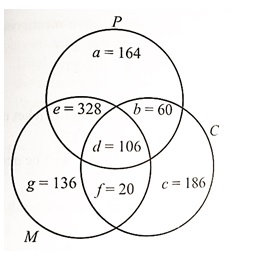
(i) 658 failed in Physics
(ii) 166 failed in Physics and Chemistry
(iii) 372 failed in Chemistry, 434 failed in Physics and Maths
(iv) 590 failed in Maths, 126 failed in Maths & Chemistry
Find the number of people who failed in (assuming that none is passed in all subjects.
We have the following equations:
a+ b + c + d + e + f + g = 1000
a + b + d + e = 658, b + d = 166
b + d + c + f = 372
d + e = 434 as in the figure.
d + e + f + g = 590, d + f = 126. Find the values
Chemistry but not in Physics.
A
318
B
198
C
213
D
206
Question 44Single Answer
Passage :
Direction: information given below and answer the question that follow.
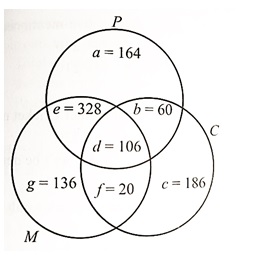
The result of an exam is given below. Out of 1000 students who appeared
(i) 658 failed in Physics
(ii) 166 failed in Physics and Chemistry
(iii) 372 failed in Chemistry, 434 failed in Physics and Maths
(iv) 590 failed in Maths, 126 failed in Maths & Chemistry
Find the number of people who failed in (assuming that none is passed in all subjects.
We have the following equations:
a+ b + c + d + e + f + g = 1000
a + b + d + e = 658, b + d = 166
b + d + c + f = 372
d + e = 434 as in the figure.
d + e + f + g = 590, d + f = 126. Find the values
Physics or Maths but not in Chemistry.
A
558
B
718
C
628
D
None of these
Question 45Single Answer
Passage :
For the next four question that follow:
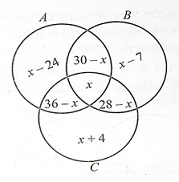
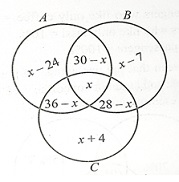
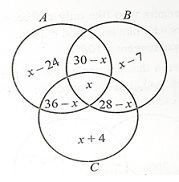
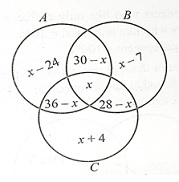
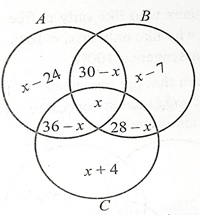
In a city, three daily newspapers A, B, C are published, 42% read A; 51% read B; 68% read C; 30% read A and B; 28% read B and C; 36% read A and C; 8% do not read any of the three newspapers.
Let x% people read all the three newspapers.
Since 8% people do not read any newspapers.
(x – 24) + (x – 7) + (x + 4) + (30 – x) + (36 – x) + (28 – x) + x = 92
→ x + 98 – 31 = 92
→ x = 92 – 67 = 25
What is the percentage of persons who read all the three papers ?
A
20%
B
25%
C
30%
D
40%
Question 46Single Answer
Passage :
For the next four : question that follow :
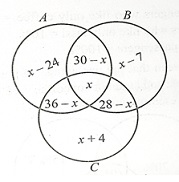
In a city, three daily newspapers A, B, C are published, 42% read A; 51% read B; 68% read C; 30% read A and B; 28% read B and C; 36% read A and C; 8% do not read any of the three newspapers.
Let x% people read all the three newspapers.
Since 8% people do not read any newspapers.
(x – 24) + (x – 7) + (x + 4) + (30 – x) + (36 – x) + (28 – x) + x = 92
→ x + 98 – 31 = 92
→ x = 92 – 67 = 25
What is the percentage of persons who read only two papers?
A
19%
B
31%
C
44%
D
None of these
Question 47Single Answer
Passage :
For the next four : question that follow :
In a city, three daily newspapers A, B, C are published, 42% read A; 51% read B; 68% read C; 30% read A and B; 28% read B and C; 36% read A and C; 8% do not read any of the three newspapers.
Let x% people read all the three newspapers.
Since 8% people do not read any newspapers.
(x – 24) + (x – 7) + (x + 4) + (30 – x) + (36 – x) + (28 – x) + x = 92
→ x + 98 – 31 = 92
→ x = 92 – 67 = 25
What is the percentage of persons who read only one paper ?
A
38%
B
48%
C
51%
D
None of these
Question 48Single Answer
Passage :
For the next four : question that follow:
In a city, three daily newspapers A, B, C are published, 42% read A; 51% read B; 68% read C; 30% read A and B; 28% read B and C; 36% read A and C; 8% do not read any of the three newspapers.
Let x% people read all the three newspapers.
Since 8% people do not read any newspapers.
(x – 24) + (x – 7) + (x + 4) + (30 – x) + (36 – x) + (28 – x) + x = 92
→ x + 98 – 31 = 92
→ x = 92 – 67 = 25
What is the percentage of persons who read only A but neither B nor C ?
A
4%
B
3%
C
1%
D
None of these
Question 49Single Answer
Passage :
For the next four : question that follow:
In a city, three daily newspapers A, B, C are published, 42% read A; 51% read B; 68% read C; 30% read A and B; 28% read B and C; 36% read A and C; 8% do not read any of the three newspapers.
Let x% people read all the three newspapers.
Since 8% people do not read any newspapers.
(x – 24) + (x – 7) + (x + 4) + (30 – x) + (36 – x) + (28 – x) + x = 92
→ x + 98 – 31 = 92
→ x = 92 – 67 = 25
If A and B are any two sets, then what is A ᴖ (A ᴗ B) equal to ?
A
Complement of A
B
Complement of B
C
B
D
A
Question 50Single Answer
Passage :
For the next four : question that follow:
In a city, three daily newspapers A, B, C are published, 42% read A; 51% read B; 68% read C; 30% read A and B; 28% read B and C; 36% read A and C; 8% do not read any of the three newspapers.
Let x% people read all the three newspapers.
Since 8% people do not read any newspapers.
(x – 24) + (x – 7) + (x + 4) + (30 – x) + (36 – x) + (28 – x) + x = 92
→ x + 98 – 31 = 92
→ x = 92 – 67 = 25
40% of the people read newspaper X, 50% read newspaper Y and 10% read both the papers. What percentage of the people read neither newspaper ?
A
10%
B
15%
C
20%
D
25%
Important Questions Package
GSSSB X Ray Technician Exam Online Question Bank Package
Buy GSSSB X Ray Technician Important Questions, MCQ, question answer in Hindi & English. It will help you to score high marks in GSSSB X Ray Technician question bank 2026 in Online, PDF & Print study material.
+ Free Monthly Current Affairs, GK & more PDF Download
Sr.
Package Name
Amount
1.
GSSSB X-Ray Technician Exam - English
Description : 1000 Question with Answer
₹101[₹500]
2.
GSSSB X-Ray Technician Exam - English
Description : 2000 Question with Answer
₹151[₹500]
3.
GSSSB X-Ray Technician Exam - English
Description : 1000 Question & Answer Download in PDF (Send by Email)
₹151[₹450]
4.
GSSSB X-Ray Technician Exam Question Bank Book - English
Description : 1000 Question with Answer (Printed Material)
₹390[₹600]
Quantitative Aptitude
Question 51Single Answer
Passage :
Read the passage below and solve the question based on it.
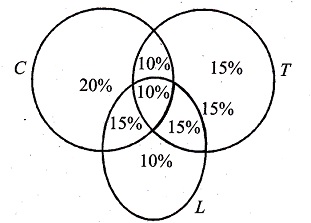
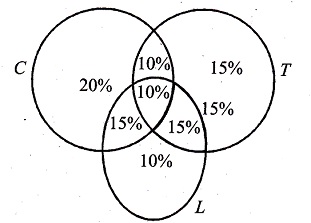
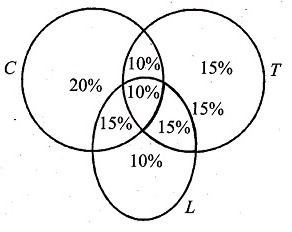
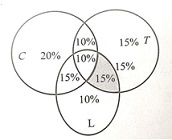
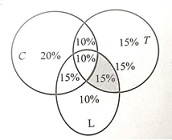
5% of the passengers do not like coffee, tea and lassi and 10% like all the three, 20% like coffee and tea, 25% like lassi and coffee and 25% like lassi and tea. 55% like coffee, 50% like tea, and 50% like lassi.
Where C = Coffee, T = Tea and L =Lassi
The passengers who like only coffee is greater than the passengers who like only lassi by
A
25%
B
100%
C
75%
D
0%
Question 52Single Answer
Passage :
Read the passage below and solve the question based on it.
5% of the passengers do not like coffee, tea and lassi and 10% like all the three, 20% like coffee and tea, 25% like lassi and coffee and 25% like lassi and tea. 55% like coffee, 50% like tea, and 50% like lassi.
Where C = Coffee, T = Tea and L =Lassi
The percentage of passengers who like both tea and lassi but not coffee, is
A
15
B
25
C
40
D
75
Question 53Single Answer
Passage :
Read the passage below and solve the question based on it.
5% of the passengers do not like coffee, tea and lassi and 10% like all the three, 20% like coffee and tea, 25% like lassi and coffee and 25% like lassi and tea. 55% like coffee, 50% like tea, and 50% like lassi.
Where C = Coffee, T = Tea and L =Lassi
The percentage passengers who like at least 2 of the coffee, tea and lassi, is
A
30
B
45
C
50
D
60
Question 54Single Answer
Passage :
Read the passage below and solve the question based on it.
5% of the passengers do not like coffee, tea and lassi and 10% like all the three, 20% like coffee and tea, 25% like lassi and coffee and 25% like lassi and tea. 55% like coffee, 50% like tea, and 50% like lassi.
Where C = Coffee, T = Tea and L =Lassi
If the number of passengers is 180, then the number of passengers who like lassi only, is
A
10
B
18
C
27
D
36
Question 55Single Answer
Passage :
Read the passage below and solve the question based on it.
5% of the passengers do not like coffee, tea and lassi and 10% like all the three, 20% like coffee and tea, 25% like lassi and coffee and 25% like lassi and tea. 55% like coffee, 50% like tea, and 50% like lassi.
Where C = Coffee, T = Tea and L =Lassi
In a town three newspapers A, B and C are published. 42% of the people in that town read A, 68% read B, 51% read C, 30% read A and B, 28% read B and C, 36% A and C and 18% do not read any paper. Find the % of the population of town that reads all the three.
A
15%
B
25%
C
20%
D
35%
Question 56Single Answer
Passage :
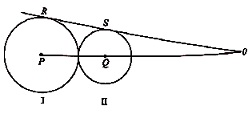
In the adjoining figure, I and II are circles with ceners P and Q respectively. The two circle touch each other and have a common tangent that touches them at points R and S respectively. This common tangent meets the line joining P and Q at O. The diameters of I and II are in the ratio 4 : 3. It is also known that the length of PO is 28 cm.
What is the ratio of the length of PQ to that of QO?
A
1 : 4
B
1 : 3
C
3 : 8
D
3 : 4
Question 57Single Answer
Passage :
A committee of five members is to be formed out of 5 Males, 6 Females and 3 Children. In how many different ways can it be done if ?
The committee should consist of 2 Males, 2 Females and 1 child ?
A
450
B
225
C
55
D
90
Question 58Single Answer
Passage :
A committee of five members is to be formed out of 5 Males, 6 Females and 3 Children. In how many different ways can it be done if ?
The committee should include all the 3 Childs?
A
90
B
180
C
21
D
55
Question 59Single Answer
Passage :
A committee of five members is to be formed out of 5 Males, 6 Females and 3 Children. In how many different ways can it be done if ?
In how many different ways can 4 boys and 3 girls be arranged in a row such that all the boys stand together and all the girls stand together ?
A
75
B
576
C
288
D
24
Question 60Single Answer
Passage :
An urn contains 4 green, 5 blue, 2 red and 3 yellow marbles.
If four marbles are drawn at random, what is the probability that two are blue and two are red ?
A
B
C
D
Indian Constitution, Current Affairs, Gujarati & English Comprehension
Question 61Single Answer
I go to Madurai by —– Vaigai Express
A
a
B
an
C
some
D
the
Question 62Single Answer
Have the car stolen!
A
Steal the car
B
You should have the stolen car
C
Get someone to steal the car
D
They have stolen the car
Question 63Single Answer
Passage :
Direction : Question below has two blanks, each blank indicting that some thing has been omitted. Choose the word for each blank which best fits the meaning of the sentence as a whole.
The Finance Department has ……………a centralized online databank system for all statutory government bodies to …………an eye on their assets and liabilities.
A
presented , stay
B
introduced , keep
C
announce , make
D
created , let
E
proclaimed , hold
Question 64Single Answer
Passage :
Direction : The five items in this section consists of a word or group of words followed by four words as (a), (b), (c) and (d). Select the word which is nearly opposite to the meaning of the original word or group of words and mark your response as (a), (b), (c) and (d), as the case may be, in your Answer Sheet.
Assets
A
liabilities
B
responsibilities
C
estates
D
profits
Question 65Single Answer
Passage :
Direction : In the question, out of the four alternatives, choose the word which is opposite in meaning to the given word and click the button corresponding to it
Affidavit
A
Affirmation
B
Slander
C
Oath
D
Testimony
Question 66Single Answer
"શાંતિ" શબ્દનો અર્થ શું છે ?
A
વાતચીત
B
આક્રમણ
C
ખેડૂત
D
ધમાધમ
Question 67Single Answer
"વ્યક્તિ" શબ્દનો વિલોમ શબ્દ શું છે ?
A
સંગઠન
B
વ્યવસ્થા
C
સંવિદાન
D
અનવરત
Question 68Single Answer
"વિકાસ" શબ્દનું અર્થ શું છે ?
A
અભિવૃદ્ધિ
B
વિઘટન
C
વિદ્યા
D
આકર્ષણ
Question 69Single Answer
"સ્થાન" શબ્દનું વિરોધી શબ્દ શું છે ?
A
ધૂપ
B
દૂર
C
જગ્યા
D
આવેશ
Question 70Single Answer
"મંજિલ" શબ્દનો વ્યાપારિક અર્થ શું છે ?
A
ગોલ
B
ધબ્બુ
C
સાંજ
D
ઉદ્દેશ
Question 71Single Answer
Which Act gave separate electorate rights to Muslims in India ?
A
The Indian Councils Act, 1909
B
The Government of India Act, 1915
C
The Government of India Act, 1919
D
The Government of India Act, 1935
Question 72Single Answer
Which one of the following made the Indian Legislature bicameral ?
A
The Indian Councils Act, 1909
B
Government of India Act, 1919
C
Government of India Act, 1935
D
Indian Independence Act, 1947
Question 73Single Answer
'Diarchy' was established in India by which of the following ?
A
The Indian Councils Act, 1909
B
The Government of India Act, 1935
C
The Government of India Act, 1919
D
None of the above
Question 74Single Answer
Which one of the following aimed at providing a federal structure for India ?
A
Indian Councils Act, 1909
B
Government of India Act, 1919
C
Government of India Act, 1935
D
Indian Independence Act, 1947
Question 75Single Answer
As a guardian of the government of India Act, 1935 a Court was constituted which was called.
A
Privy Council
B
Supreme Court
C
High Court
D
Federal Court
Question 76Single Answer
Under the Government of India Act 1935, the Federal court had -
A
Original jurisdiction only
B
Appellate jurisdiction only
C
Advisory jurisdiction only
D
Original, appellate and advisory jurisdiction
Question 77Single Answer
Under the Government of India's Act 1935, how many Governors and Chief Commissioners provinces constituted in British India ?
A
14 and 7
B
11 and 7
C
15 and 9
D
None of the above
Question 78Single Answer
The Mountbaten plan led to the enactment of :
A
Government of India Act, 1919
B
Government of India Act, 1935
C
The Indian Independence Act, 1947
D
None of the above
Question 79Single Answer
The plan of Lord Mountbatten was excepted by the congress and the muslim league. The British Parliament enacted the Indian Independence act, 1947 which got Royal assistant on -
A
3 June, 1947
B
4 July, 1947
C
15 July, 1947
D
18 July, 1947
Question 80Single Answer
Which one of the following relates to transfer of power to the Indians and partition of the country ?
A
Simon Commission
B
Cripps Mission
C
Cabinet Mission Plan
D
The Mountbatten plan
Question 81Single Answer
Which country holds the BRICS Chairmanship in 2026?
A
Brazil
B
Russia
C
China
D
India
Question 82Single Answer
What is the theme of India’s BRICS Chairmanship 2026?
A
Inclusive Growth for All
B
Sustainable Global Economy
C
One Earth One Future
D
Building for Resilience, Innovation, Cooperation and Sustainability
Question 83Single Answer
Where was the BRICS Foreign Ministers' Meeting held in May 2026?
A
Mumbai
B
Hyderabad
C
Bengaluru
D
New Delhi
Question 84Single Answer
Which summit on Artificial Intelligence was hosted by India in February 2026?
A
World AI Congress
B
AI Action Summit
C
India AI Impact Summit 2026
D
Global AI Forum
Question 85Single Answer
Where was the India AI Impact Summit 2026 organized?
A
Pragati Maidan, Delhi
B
Vigyan Bhawan, New Delhi
C
Bharat Mandapam, New Delhi
D
Hyderabad International Convention Centre
Question 86Single Answer
Which ministry organized the India AI Impact Summit 2026?
A
Ministry of Science and Technology
B
Ministry of Electronics and Information Technology
C
Ministry of Commerce
D
Ministry of Education
Question 87Single Answer
Which city is expected to host the G20 Summit 2026?
A
New York
B
Washington D.C.
C
Miami
D
Los Angeles
Question 88Single Answer
Which country is scheduled to host the BRICS Summit 2026?
A
China
B
India
C
South Africa
D
Brazil
Question 89Single Answer
Which country is expected to host COP31 Climate Summit 2026?
A
France
B
UAE
C
Germany
D
Turkey
Question 90Single Answer
Which city hosted the Regional AI Impact Conference 2026?
A
Chennai
B
Jaipur
C
Pune
D
Kochi
Technical Subject (X Ray Technician)
Question 91Single Answer
Roentgen rays were discovered in the year?
A
1890
B
1910
C
1901
D
1895
Question 92Single Answer
X-rays belong to which part of the electromagnetic spectrum?
A
Radio waves
B
Infrared
C
Visible light
D
High energy electromagnetic waves
Question 93Single Answer
The nature of X-rays is?
A
Electromagnetic waves
B
Mechanical waves
C
Matter waves
D
Sound waves
Question 94Single Answer
X-rays are produced mainly in which part of X-ray tube?
A
Glass envelope
B
Target (anode)
C
Filament
D
Cooling system
Question 95Single Answer
Electrons in an X-ray tube are emitted from?
A
Cathode filament
B
Anode
C
Glass wall
D
Cooling oil
Question 96Single Answer
The process of X-ray production is called?
A
Ionization
B
Reflection
C
Diffraction
D
Bremsstrahlung
Question 97Single Answer
Characteristic X-rays are produced when?
A
Electron slows down
B
Nucleus breaks
C
Inner shell electron is removed
D
Atom becomes stable
Question 98Single Answer
X-ray tube target is usually made of?
A
Copper
B
Aluminium
C
Tungsten
D
Iron
Question 99Single Answer
X-ray beam produced from tube is?
A
Monoenergetic
B
Polychromatic
C
Coherent
D
Polarized
Question 100Single Answer
The quantity of X-rays produced depends on?
A
Tube current
B
Tube glass
C
Filter only
D
Screen only
Question 101Single Answer
The quality of X-rays depends on?
A
Film size
B
mA
C
Time only
D
kVp
Question 102Single Answer
X-ray generators are used to supply?
A
DC high voltage
B
AC only
C
Low voltage AC
D
Mechanical energy
Question 103Single Answer
Step-up transformer in X-ray circuit increases?
A
Current
B
Voltage
C
Resistance
D
Frequency
Question 104Single Answer
Step-down transformer in X-ray machine reduces?
A
Heat
B
Voltage
C
Light
D
Electron speed
Question 105Single Answer
Attenuation of X-rays means?
A
Increase in intensity
B
Increase in energy
C
Reduction in intensity
D
Polarization
Question 106Single Answer
Main interaction responsible for diagnostic X-rays is?
A
Pair production
B
Nuclear fission
C
Photoelectric effect
D
Fusion
Question 107Single Answer
Compton effect results in?
A
No scattering
B
Heat production only
C
Only absorption
D
Scattered photon and electron
Question 108Single Answer
Filters in X-ray beam are used to remove?
A
Low energy photons
B
Hard rays
C
High energy photons
D
Electrons
Question 109Single Answer
Most common filter material is?
A
Lead
B
Tungsten
C
Copper
D
Aluminium
Question 110Single Answer
Grids in radiography are used to reduce?
A
Primary radiation
B
kVp
C
Tube current
D
Scatter radiation
Question 111Single Answer
Grid ratio is related to?
A
Thickness of film
B
Tube voltage
C
Height of lead strips
D
Exposure time
Question 112Single Answer
Magnification in radiography increases when?
A
Object closer to detector
B
mA increased
C
kVp increased
D
Object farther from detector
Question 113Single Answer
Intensifying screens are used to?
A
Reduce contrast
B
Block X-rays completely
C
Increase noise
D
Convert X-rays to light
Question 114Single Answer
Material used in intensifying screen is?
A
Phosphor
B
Glass
C
Copper
D
Plastic only
Question 115Single Answer
Fluoroscopic screen produces image in?
A
Static form
B
Real-time
C
No image
D
Only film
Question 116Single Answer
Digital radiography uses which type of detector?
A
Film screen
B
Electronic detector
C
Cassette only
D
Fluoroscopic screen
Question 117Single Answer
Computed radiography primarily uses?
A
Photostimulable phosphor plate
B
CCD camera
C
Gas detector
D
MRI coil
Question 118Single Answer
In CR, latent image is stored in?
A
Phosphor plate
B
Film
C
Lead sheet
D
Grid
Question 119Single Answer
The laser used in CR system is used for?
A
Reading latent image
B
Exposure
C
Cooling system
D
Filtration
Question 120Single Answer
The emitted light from CR plate is called?
A
Fluorescence
B
Absorption
C
Scattering
D
Photostimulated luminescence
Question 121Single Answer
In DR system, image is formed directly by?
A
Chemical reaction
B
Digital signal conversion
C
Heat emission
D
Magnetic field
Question 122Single Answer
Direct conversion in DR uses?
A
CsI
B
Lead
C
a-Se (amorphous selenium)
D
Calcium fluoride
Question 123Single Answer
Indirect conversion in DR uses?
A
Photodiode only
B
Grid only
C
Film only
D
Scintillator + photodiode
Question 124Single Answer
CsI in DR acts as?
A
Conductor
B
Filter
C
Scintillator
D
Grid
Question 125Single Answer
The main advantage of DR is?
A
Slow processing
B
Immediate image availability
C
Chemical processing
D
Film use
Question 126Single Answer
Radiographic unsharpness is also called?
A
Density
B
Contrast
C
Blur
D
Noise
Question 127Single Answer
Geometric unsharpness depends mainly on?
A
mA only
B
Focal spot size
C
kVp only
D
Exposure time
Question 128Single Answer
Motion unsharpness is caused by?
A
Grid movement
B
Patient movement
C
Tube heating
D
Filtration
Question 129Single Answer
Unsharpness increases when object is placed?
A
Near detector
B
Far from detector
C
At focal spot
D
Inside tube
Question 130Single Answer
Increasing source-to-image distance (SId) generally causes unsharpness to?
A
Increase
B
Decrease
C
Remain same
D
Become zero
Question 131Single Answer
Density in radiography refers to?
A
Image sharpness
B
Contrast only
C
Degree of blackening
D
Noise level
Question 132Single Answer
Radiographic density increases with?
A
Increased mA
B
Decreased mA
C
Decreased kVp
D
Increased filtration
Question 133Single Answer
Increasing exposure time increases?
A
Blur only
B
Distortion
C
Noise
D
Density
Question 134Single Answer
Increasing kVp generally increases?
A
Grid ratio
B
Noise
C
Motion only
D
Density
Question 135Single Answer
Contrast in radiography refers to?
A
Image size
B
Tube current
C
Exposure time
D
Difference in densities
Question 136Single Answer
The unit Roentgen (R) measures?
A
Absorbed dose
B
Equivalent dose
C
Exposure in air
D
Effective dose
Question 137Single Answer
01 Gy
c) 10 Gy
d) 100 Gy
Question 138Single Answer
SI unit of absorbed dose is?
A
rad
B
rem
C
gray
D
roentgen
Question 139Single Answer
1 gray is equal to?
A
10 rad
B
1 rad
C
100 rad
D
1000 rad
Question 140Single Answer
The unit rem is used for?
A
Equivalent dose
B
Exposure
C
Activity
D
Energy
Question 141Single Answer
SI unit of equivalent dose is?
A
gray
B
rad
C
sievert
D
roentgen
Question 142Single Answer
Dosimetry is the measurement of?
A
Sound
B
Temperature
C
Radiation dose
D
Pressure
Question 143Single Answer
Personal dosimeter is used to measure?
A
Worker exposure
B
Patient dose only
C
Machine output
D
Room temperature
Question 144Single Answer
TLD stands for?
A
Thermal Light Device
B
Total Light Detector
C
Thermo Luminescent Dosimeter
D
Tube Level Detector
Question 145Single Answer
Film badge is used for?
A
Image formation
B
Radiation monitoring
C
Tube cooling
D
Filtration
Question 146Single Answer
Radiation effects are classified into?
A
Deterministic and stochastic
B
Direct and indirect only
C
Acute and chronic only
D
Physical and chemical
Question 147Single Answer
Deterministic effects have?
A
No threshold
B
Random occurrence
C
Threshold dose
D
No relation with dose
Question 148Single Answer
Stochastic effects are?
A
Dose-dependent severity
B
Always fatal
C
Random in nature
D
Always immediate
Question 149Single Answer
Example of deterministic effect is?
A
Cancer
B
Skin erythema
C
Mutation
D
Leukemia
Question 150Single Answer
Long-term radiation effect includes?
A
Nausea
B
Cancer
C
Burns
D
Hair loss only
Question 151Single Answer
Most radiosensitive tissue is?
A
Bone marrow
B
Muscle
C
Bone
D
Nerve
Question 152Single Answer
Least radiosensitive tissue is?
A
Lymph tissue
B
Muscle
C
Skin
D
Gonads
Question 153Single Answer
ALARA principle means?
A
Always Limit Annual Radiation Amount
B
As Long As Radiation Allowed
C
As Low As Reasonably Achievable
D
As Light As Radiation Allowed
Question 154Single Answer
Time as protection factor means?
A
Increase exposure time
B
Reduce exposure time
C
Increase mA
D
Increase kVp
Question 155Single Answer
Distance protection is based on?
I \propto \frac{1}{d^2}
A
Direct law
B
Inverse square law
C
Linear law
D
Exponential law
Question 156Single Answer
Shielding in radiation protection uses?
A
Plastic
B
Glass
C
Wood
D
Lead
Question 157Single Answer
Lead apron is used to protect?
A
Machine
B
Grid
C
Film
D
Patient and staff
Question 158Single Answer
Gonadal shielding is used to protect?
A
Heart
B
Brain
C
Liver
D
Reproductive organs
Question 159Single Answer
Primary radiation barrier is?
A
Door
B
Wall facing tube
C
Ceiling
D
Floor
Question 160Single Answer
Secondary barrier protects from?
A
Scatter and leakage radiation
B
Primary beam only
C
Heat
D
Light
Question 161Single Answer
AERB stands for?
A
Advanced Energy Research Board
B
Atomic Energy Radiation Bureau
C
Atomic Energy Regulatory Board
D
Atomic Electron Radiation Bureau
Question 162Single Answer
AERB is responsible for?
A
Radiation safety regulation
B
Manufacturing X-ray machines
C
Film processing
D
Patient registration
Question 163Single Answer
AERB is under?
A
WHO
B
Government of India
C
UNO
D
State government
Question 164Single Answer
AERB guidelines ensure?
A
Radiation safety standards
B
Higher radiation exposure
C
Machine speed
D
Film quality only
Question 165Single Answer
Controlled area in radiology means?
A
Public area
B
Radiation area with restrictions
C
Waiting room
D
Office area
Question 166Single Answer
The primary purpose of a dark room is to?
A
Increase radiation
B
Process radiographic films
C
Produce X-rays
D
Store cassettes
Question 167Single Answer
The dark room must be?
A
Brightly lit
B
Transparent
C
Open air
D
Light proof
Question 168Single Answer
Safe light in dark room is usually?
A
Red or amber light
B
Blue light only
C
White light
D
Green light only
Question 169Single Answer
Dark room should have temperature around?
A
10°C
B
50°C
C
40°C
D
18–24°C
Question 170Single Answer
Relative humidity in dark room should be?
A
40–60%
B
30–40%
C
10–20%
D
90–100%
Question 171Single Answer
Film processing starts with?
A
Fixing
B
Drying
C
Washing
D
Developing
Question 172Single Answer
Developing converts latent image into?
A
Invisible image
B
Electrical signal
C
Visible image
D
Heat energy
Question 173Single Answer
Fixer removes?
A
Lead
B
Silver halides
C
Calcium
D
Barium
Question 174Single Answer
Washing removes?
A
Developer only
B
Heat
C
X-rays
D
Chemicals from film
Question 175Single Answer
Drying removes?
A
Moisture
B
Light
C
Radiation
D
Silver
Question 176Single Answer
Digital Subtraction Angiography (DSA) is mainly used to visualize?
A
Blood vessels
B
Bone only
C
Lung tissue
D
Soft tissue only
Question 177Single Answer
In DSA, subtraction is performed between?
A
Two ultrasound images
B
X-ray and CT images
C
MRI and CT images
D
Mask and contrast images
Question 178Single Answer
The main purpose of DSA is to remove?
A
Background bone and soft tissue
B
Noise
C
Radiation
D
Contrast agent
Question 179Single Answer
Contrast medium used in angiography is usually?
A
Iodine-based
B
Barium sulfate
C
Air only
D
Saline only
Question 180Single Answer
Spiral CT is also known as?
A
Step-and-shoot CT
B
Conventional CT
C
Helical CT
D
Static CT
Question 181Single Answer
In spiral CT, patient movement is?
A
Interrupted
B
Continuous
C
Not allowed
D
Manual only
Question 182Single Answer
Multislice CT uses?
A
Single detector
B
No detector
C
Multiple detector rows
D
Film system
Question 183Single Answer
Advantage of multislice CT is?
A
Faster acquisition
B
Slower imaging
C
No radiation
D
Lower resolution
Question 184Single Answer
CT image is reconstructed using?
A
Sound waves
B
Optical lenses
C
Magnetic field
D
Computer algorithms
Question 185Single Answer
CT number is expressed in?
A
Hounsfield units
B
Gray units
C
Tesla
D
Roentgen
Question 186Single Answer
Hounsfield unit of water is?
A
-1000
B
+1000
C
0
D
+500
Question 187Single Answer
Hounsfield unit of air is?
A
0
B
+100
C
+1000
D
-1000
Question 188Single Answer
CT scan uses radiation in form of?
A
Alpha rays
B
X-rays
C
Gamma rays only
D
Radio waves
Question 189Single Answer
Slice thickness in CT refers to?
A
Patient size
B
Detector weight
C
Tube size
D
Thickness of image section
Question 190Single Answer
Gantry in CT contains?
A
Display monitor
B
Film processor
C
X-ray tube and detectors
D
Injector only
Question 191Single Answer
CT scanner rotation speed affects?
A
Patient comfort only
B
Image acquisition time
C
Film size
D
Contrast medium
Question 192Single Answer
Helical CT allows?
A
Intermittent scanning
B
No scanning
C
Continuous volume scanning
D
Manual scanning only
Question 193Single Answer
CT contrast media is mainly?
A
Air
B
Saline only
C
Barium only
D
Iodinated compounds
Question 194Single Answer
Ultrasound imaging uses?
A
X-rays
B
Sound waves
C
Magnetic fields
D
Gamma rays
Question 195Single Answer
Frequency of diagnostic ultrasound is typically?
A
1–20 MHz
B
1–20 Hz
C
1–20 kHz
D
100 MHz
Question 196Single Answer
The main role of a computer in modern radiography is?