Latest GSSSB Pharmacist Exam Question (Objective Questions), MCQ in English
Subjects : Reasoning & Data Interpretation, Quantitative Aptitude, Constitution of India, Current Affairs & Comprehension, Technical Subject (Ayurveda)
Question Bank GSSSB Pharmacist/Compounder (Ayurveda) Exam - English
How many such pairs of letters are there in the word ‘CLEANLINESS’ each of the which has as many letters between them in the word as they have in the English alphabet, in the same sequence?
A
Two
B
Three
C
Five
D
Four
E
None of these
Question 2Single Answer
Team A has scored more goals than Team B
Team C has scored fewer goals than Team B
Team A has scored fewer goals than Team C .
If the first two statements are true, the third statement is
A
True
B
False
C
Uncertain
D
None
Question 3Single Answer
If it is possible to make only one meaningful word with the second, the third, the sixth and the eight letters of the word FRAGMENT using each only once, which of the following will be the third letter of that word ? If no such word can be formed, give ‘X’ as the answer and if more than one such word can be formed, give ‘Y’ as the answer.
A
A
B
E
C
T
D
X
E
Y
Question 4Single Answer
How many such letters are there in the word ORIENTAL each of which is as far away from the beginning of the word as when they are arranged alphabetically?
A
None
B
One
C
Two
D
Three
E
More than three
Question 5Single Answer
How many such pairs of letters in the word CREDIT each of which has as many letters between them in the word as in the English alphabet?
A
None
B
One
C
Two
D
Three
E
More than three
Question 6Single Answer
How many meaningful words can be made from the letters ‘LMEA’ using each letter only once in each word?
A
None
B
One
C
Two
D
Three
E
More than three
Question 7Single Answer
If it is possible to make only one meaningful word with the first, the second, the seventh and the eighth letters of the word TEMPORAL, which of the following will be the first letter of that word? If more than one such word can be made, give ‘Y’ as the answer and if no such word can be made, give ‘X’ as the answer.
A
T
B
L
C
E
D
Y
E
X
Question 8Single Answer
If the letters of the word HANDOVER are arranged alphabetically from left to right how many letters will remain at the same position?
A
None
B
One
C
Two
D
Three
E
More than three
Question 9Single Answer
Passage :
A B C D E F G H I J K L M N O P Q R S T U V W X Y Z .
Which letter in this alphabet is the eighth letter to the right of the letter and which is tenth letter to the left of the last but one letter of the alphabet ?
A
X
B
W
C
I
D
H
Question 10Single Answer
Passage :
Direction : The following question is based on the five words given below:
AND FOR THE BIG SUM (The new words formed after performing the mentioned operations may or may not necessarily the meaningful English words.)
If the third alphabet of each of the words is changed to the next alphabet in the English alphabetical series, which of the following will form a meaningful English word?
A
SUM
B
BIG
C
Both BIG and THE
D
FOR
E
Both FOR and BIG
Question 11Single Answer
Passage :
Direction : The following question is based on the five words given below:
AND FOR THE BIG SUM (The new words formed after performing the mentioned operations may or may not necessarily the meaningful English words.)
If the given words are arranged in the order as they would appear in a dictionary from left to right, which of the following will be second from the right ?
A
AND
B
FOR
C
THE
D
BIG
E
SUM
Question 12Single Answer
Passage :
Direction: The following question is based on the five words given below:
AND FOR THE BIG SUM (The new words formed after performing the mentioned operations may or may not necessarily the meaningful English words.)
If second alphabet in each of the words is changed to next alphabet in the English alphabetical order, how many words having two vowels (same or different vowels) will be formed ?
A
None
B
One
C
Two
D
Three
E
Four
Question 13Single Answer
Passage :
Direction : The following question is based on the five words given below:
AND FOR THE BIG SUM (The new words formed after performing the mentioned operations may or may not necessarily the meaningful English words.)
How many letters are there in the English alphabetical series between the second letter of the word which is second from the right and the second letter of the word which is second from the left of the given words?
A
Two
B
Five
C
Six
D
Nine
E
Three
Question 14Single Answer
Passage :
Direction: The following question is based on the five words given below:
AND FOR THE BIG SUM (The new words formed after performing the mentioned operations may or may not necessarily the meaningful English words.)
If in each of the given words, each of the consonant is changed to previous letter and each vowel is changed to next letter in the English alphabetical series, in how many words thus formed will no vowels appear?
A
None
B
One
C
Two
D
Three
E
More than three
Question 15Single Answer
Passage :
Direction : Following question is based on five words given below: BRU LEGINKCATOWN
(The new words formed after performing the mentioned operations may or may not necessarily be meaningful English words)
If the third alphabet in each of the words is changed to the next alphabet in the English alphabetical order, how many words having two vowels (same or different vowels) will be formed?
A
None
B
One
C
Two
D
Three
E
Four
Question 16Single Answer
Passage :
Direction : Following question is based on five words given below: BRU LEGINKCATOWN
(The new words formed after performing the mentioned operations may or may not necessarily be meaningful English words)
If the position of the first and the second alphabets of each of the words are interchanged, which of the following will form a meaningful English word?
A
Both CAT and OWN
B
Both BRU and INK
C
Only CAT
D
Only INK
E
Only LEG
Question 17Single Answer
Passage :
Direction: Following question is based on five words given below: BRU LEGINKCATOWN
(The new words formed after performing the mentioned operations may or may not necessarily be meaningful English words)
If the given words are arranged in the order as they would appear in a dictionary from left to right, which of the following will be exactly in the middle of the five words?
A
OWN
B
LEG
C
BRU
D
CAT
E
INK
Question 18Single Answer
Passage :
Direction: Following question is based on five words given below: BRU LEGINKCATOWN
(The new words formed after performing the mentioned operations may or may not necessarily be meaningful English words)
If in each of the given words, each of the consonants is changed to previous letter and each vowel is changed to next letter in the English alphabetical series, in how many words thus formed will the same alphabet appear twice?
A
None
B
One
C
Two
D
Three
E
More than three
Question 19Single Answer
Passage :
Find the missing number in the following series ?
3, 5, 5, 19, 7, 41, 9, ?
A
71
B
61
C
79
D
69
Question 20Single Answer
Passage :
Direction: following question is based on five words given below:
LAP BUT CAR SON HID
(The new words formed after performing the mentioned operations may or may not necessarily be meaningful English words.)
If the positions of the first and the third alphabets of each of the words are interchanged, which of the following would form meaningful words with the new arrangement?
A
HID
B
SON
C
Both LAP and BUT
D
CAR
E
Both CAR and LAP
Question 21Single Answer
Passage :
Direction : Each of the questions below consists of a question and two statements numbered (I) and (II) given below it. You have to decide whether the data provided in the statements are sufficient to answer the question. Read both the statements and give answer :
How many employees of bank ‘X’ opted for VRS ?
(I) 18% of the 950 officer cadre employees and 6% of the 1100 of all other cadre employees opted for VRS. (II) 28% of the employees in the age group of 51 to 56 and 17% of the employees in all other age groups opted for VRS.
A
Statement (I) ALONE is sufficient, but statement (II) alone is not sufficient
B
Statement (II) ALONE is sufficient, but statement (I) alone is not sufficient
C
BOTH statements TOGETHER are sufficient, but NEITHER statement alone is sufficient
D
EACH statement ALONE is sufficient
Question 22Single Answer
Passage :
Direction : Each of the questions below consists of a question and two statements numbered (I) and (II) given below it. You have to decide whether the data provided in the statements are sufficient to answer the question. Read both the statements and give answer :
The area of a playground is 1600 square meters. What is its perimeter ?
(I) It is a perfect square playground
(II) It costs Rs.3200 to put a fence around the playground at the rate of Rs.20 per meter.
A
Statement (I) ALONE is sufficient, but statement (II) alone is not sufficient
B
Statement (II) ALONE is sufficient, but statement (I) alone is not sufficient
C
BOTH statements TOGETHER are sufficient, but NEITHER statement alone is sufficient
D
EACH statement ALONE is sufficient
Question 23Single Answer
Passage :
Direction : Each of the questions below consists of a question and two statements numbered (I) and (II) given below it. You have to decide whether the data provided in the statements are sufficient to answer the question. Read both the statements and give answer :
What is the value of m – n ÷ 37 ?
(I) m is the largest possible six-digit number and n is the smallest possible six-digit number.
(II) The difference between m and n is known.
A
Statement (I) ALONE is sufficient, but statement (II) alone is not sufficient
B
Statement (II) ALONE is sufficient, but statement (I) alone is not sufficient
C
BOTH statements TOGETHER are sufficient, but NEITHER statement alone is sufficient
D
EACH statement ALONE is sufficient
Question 24Single Answer
Passage :
Direction : Each of the questions below consists of a question and two statements numbered (I) and (II) given below it. You have to decide whether the data provided in the statements are sufficient to answer the question. Read both the statements and give answer :
What is the value of x ?
(I) If 10 is added to x, the result is 34.
(II) If x is multiplied by y, the result is 38.
A
Statement (I) ALONE is sufficient, but statement (II) alone is not sufficient
B
Statement (II) ALONE is sufficient, but statement (I) alone is not sufficient
C
BOTH statements TOGETHER are sufficient, but NEITHER statement alone is sufficient
D
EACH statement ALONE is sufficient
Question 25Single Answer
Passage :
Direction : Each of the questions below consists of a question and two statements numbered (I) and (II) given below it. You have to decide whether the data provided in the statements are sufficient to answer the question. Read both the statements and give answer :
What was the total compound interest on a sum after three years ?
(I) The interest after one year was Rs. 100 and the sum after was Rs.1000.
(II) The difference between simple and compound interest on a sum of Rs.1000 at the end of two years was Rs.10.
A
Statement (I) ALONE is sufficient, but statement (II) alone is not sufficient
B
Statement (II) ALONE is sufficient, but statement (I) alone is not sufficient
C
BOTH statements TOGETHER are sufficient, but NEITHER statement alone is sufficient
D
EACH statement ALONE is sufficient
Question 26Single Answer
Passage :
Each of the questions below consists of a question and two statements numbered (1) and (2) given below it. You have to decide whether the data provided in the statements are sufficient to answer the question. Read both the statements and give answer.
Among Japanese Yen, Australian Dollar, Hong Kong Dollar and Singapore Dollar, which currency has the lowest value in terms of Indian rupees ?
(1) One rupee is equal to 2.56 Japanese Yen, 0.338 Australian Dollar, and 0.465 Hong Kong Dollar.
(2) Value of Australian Dollar is equal to Singapore Dollar.
A
Statement (1) ALONE is sufficient, but statement (2) alone is not sufficient
B
Statement (2) ALONE is sufficient, but statement (I) alone is not sufficient
C
BOTH statements TOGETHER are sufficient, but NEITHER statement alone is sufficient
D
Statements (1) and (2) TOGETHER are NOT sufficient
Question 27Single Answer
Passage :
Each of the questions below consists of a question and two statements numbered (1) and (2) given below it. You have to decide whether the data provided in the statements are sufficient to answer the question. Read both the statements and give answer.
What is the value of a two-digit number ?
(1) The sum of the two digits is 4.
(2) The difference between the two digits is 2.
A
Statement (1) ALONE is sufficient, but statement (2) alone is not sufficient
B
Statement (2) ALONE is sufficient, but statement (I) alone is not sufficient
C
BOTH statements TOGETHER are sufficient, but NEITHER statement alone is sufficient
D
Statements (1) and (2) TOGETHER are NOT sufficient
Question 28Single Answer
Passage :
Each of the questions below consists of a question and two statements numbered (1) and (2) given below it. You have to decide whether the data provided in the statements are sufficient to answer the question. Read both the statements and give answer.
What was the population of State ‘A’ in 1999 ?
(1) Population of the State increases every year by 20% and its population in 1997 was 1,20,000.
(2) Population of State A in 1997 was twice that of State B in the same year.
A
Statement (1) ALONE is sufficient, but statement (2) alone is not sufficient
B
Statement (2) ALONE is sufficient, but statement (I) alone is not sufficient
C
BOTH statements TOGETHER are sufficient, but NEITHER statement alone is sufficient
D
Statements (1) and (2) TOGETHER are NOT sufficient
Question 29Single Answer
Passage :
Each of the questions below consists of a question and two statements numbered (1) and (2) given below it. You have to decide whether the data provided in the statements are sufficient to answer the question. Read both the statements and give answer.
What is the speed of the boat in still water ?
(1) It takes 2 hours to cover the distance between A and B downstream.
(2) It takes 4 hours to cover the distance between A and B upstream.
A
Statement (1) ALONE is sufficient, but statement (2) alone is not sufficient
B
Statement (2) ALONE is sufficient, but statement (I) alone is not sufficient
C
BOTH statements TOGETHER are sufficient, but NEITHER statement alone is sufficient
D
Statements (1) and (2) TOGETHER are NOT sufficient
Question 30Single Answer
Passage :
Each of the questions below consists of a question and two statements numbered (1) and (2) given below it. You have to decide whether the data provided in the statements are sufficient to answer the question. Read both the statements and give answer.
How many vinyl squares with sides 5 inches long will be needed to cover the rectangular floor of a room ?
(1) The floor is 5ft long.
(2) The floor is 3 ft wide.
A
Statement (1) ALONE is sufficient, but statement (2) alone is not sufficient
B
Statement (2) ALONE is sufficient, but statement (I) alone is not sufficient
C
BOTH statements TOGETHER are sufficient, but NEITHER statement alone is sufficient
D
Statements (1) and (2) TOGETHER are NOT sufficient
Quantitative Aptitude
Question 31Single Answer
The cash difference between the selling prices of an article at a profit of 4% and 6% is Rs. 3. The ratio of the two selling prices is:__________ ?
A
51:52
B
52:53
C
51:53
D
52:55
Question 32Single Answer
Which of the following numbers is irrational ?
A
√49
B
0.125
C
√2
D
22/7
Question 33Single Answer
356 x 936 – 356 x 836 = ?
A
35600
B
34500
C
9630
D
93600
Question 34Single Answer
Arrange in descending order: 5/8, 7/10, 3/4
A
3/4 > 7/10 > 5/8
B
7/10 > 3/4 > 5/8
C
3/4 > 5/8 > 7/10
D
5/8 > 7/10 > 3/4
Question 35Single Answer
What is (3^{4} times 9^{2}) ?
A
36
B
38
C
310
D
96
Question 36Single Answer
If 34X-2 = 729, then find the value of X.
A
4
B
3
C
2
D
5
Question 37Single Answer
Convert 0.6 into fraction ?
A
3/5
B
2/3
C
4/5
Question 38Single Answer
The no. plate of a bus had peculiarity. The bus number was a perfect square. It was also a perfect square when the plate numbers were reversed. The bus company had only five hundred buses numbered from 1 to 500. What was the number ?
A
169
B
36
C
196
D
Can not say
Question 39Single Answer
If a and b are positive integers, such that ab = 125, then (a-b)a+b-4 = ?
A
16
B
25
C
28
D
30
Question 40Single Answer
If x*y = x2 + y2 – xy, then value of 9*11 is
A
93
B
103
C
60.5
D
121
Question 41Single Answer
Which is greater ?
A
15/16
B
17/18
C
Equal
D
Cannot compare
Question 42Single Answer
If sum of two numbers is 42 and their product is 437, then find their difference.
A
3
B
4
C
5
D
7
Question 43Single Answer
Write the 44000 in Roman numerals
A
XLI
B
XLVI
C
XLIV
D
XLVIC
Question 44Single Answer
Convert 0.0909… into fraction ?
A
1/11
B
9/11
C
1/9
D
9/10
Question 45Single Answer
What is (98 times 102) ?
A
9996
B
10000
C
10096
D
10196
Question 46Single Answer
Which is smaller ?
A
9/11
B
7/9
C
Equal
D
Cannot compare
Question 47Single Answer
Convert 0.5777… into fraction ?
A
26/45
B
52/90
C
13/22
D
5/9
Question 48Single Answer
Convert 0.81 into fraction ?
A
81/100
B
9/10
C
8/9
D
9/11
Question 49Single Answer
(63)2 – (12)2 =?
A
3528
B
3852
C
3582
D
3825
Question 50Single Answer
Which is greater ?
A
13/17
B
11/14
C
Equal
D
Cannot compare
Important Questions Package
GSSSB Pharmacist Exam Online Question Bank Package
Buy GSSSB Pharmacist Important Questions, MCQ, question answer in Hindi & English. It will help you to score high marks in GSSSB Pharmacist question bank 2026 in Online, PDF & Print study material.
+ Free Monthly Current Affairs, GK & more PDF Download
Sr.
Package Name
Amount
1.
GSSSB Pharmacist/Compounder (Ayurveda) Exam - English
Description : 1000 Question with Answer
₹101[₹500]
2.
GSSSB Pharmacist/Compounder (Ayurveda) Exam - English
Description : 2000 Question with Answer
₹151[₹500]
3.
GSSSB Pharmacist/Compounder (Ayurveda) Exam - English
Description : 2500 Question with Answer
₹171[₹450]
4.
GSSSB Pharmacist/Compounder (Ayurveda) Exam - English
Description : 1000 Question & Answer Download in PDF (Send by Email)
₹151[₹450]
5.
GSSSB Pharmacist/Compounder (Ayurveda) Exam Question Bank Book - English
Description : 1000 Question with Answer (Printed Material)
₹390[₹600]
Quantitative Aptitude
Question 51Single Answer
16.928 + 24.7582 5.015 =?
A
20
B
24
C
22
D
26
Question 52Single Answer
Convert 0.75 into fraction ?
A
3/4
B
2/3
C
4/5
D
5/8
Question 53Single Answer
Which is greater ?
A
11/13
B
12/15
C
Equal
D
Cannot compare
Question 54Single Answer
Two numbers are co-prime if their HCF is ?
A
0
B
1
C
Same
D
Prime
Question 55Single Answer
Product of all factors of 10 is ?
A
10
B
100
C
1000
D
10000
Question 56Single Answer
Passage :
information given below and answer the question that follow.
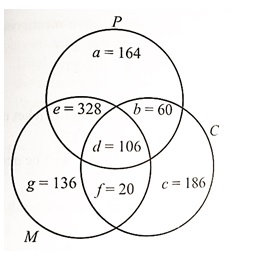
The result of an exam is given below. Out of 1000 students who appeared
(i) 658 failed in Physics
(ii) 166 failed in Physics and Chemistry
(iii) 372 failed in Chemistry, 434 failed in Physics and Maths
(iv) 590 failed in Maths, 126 failed in Maths & Chemistry
Find the number of people who failed in (assuming that none is passed in all subjects.
We have the following equations:
a+ b + c + d + e + f + g = 1000
a + b + d + e = 658, b + d = 166
b + d + c + f = 372
d + e = 434 as in the figure.
d + e + f + g = 590, d + f = 126. Find the values
Chemistry but not in Physics.
A
318
B
198
C
213
D
206
Question 57Single Answer
Passage :
Direction: information given below and answer the question that follow.
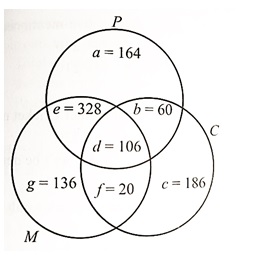
The result of an exam is given below. Out of 1000 students who appeared
(i) 658 failed in Physics
(ii) 166 failed in Physics and Chemistry
(iii) 372 failed in Chemistry, 434 failed in Physics and Maths
(iv) 590 failed in Maths, 126 failed in Maths & Chemistry
Find the number of people who failed in (assuming that none is passed in all subjects.
We have the following equations:
a+ b + c + d + e + f + g = 1000
a + b + d + e = 658, b + d = 166
b + d + c + f = 372
d + e = 434 as in the figure.
d + e + f + g = 590, d + f = 126. Find the values
Physics or Maths but not in Chemistry.
A
558
B
718
C
628
D
None of these
Question 58Single Answer
Passage :
For the next four question that follow:
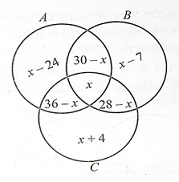
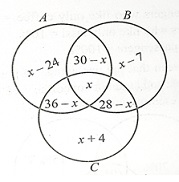
In a city, three daily newspapers A, B, C are published, 42% read A; 51% read B; 68% read C; 30% read A and B; 28% read B and C; 36% read A and C; 8% do not read any of the three newspapers.
Let x% people read all the three newspapers.
Since 8% people do not read any newspapers.
(x – 24) + (x – 7) + (x + 4) + (30 – x) + (36 – x) + (28 – x) + x = 92
→ x + 98 – 31 = 92
→ x = 92 – 67 = 25
What is the percentage of persons who read all the three papers ?
A
20%
B
25%
C
30%
D
40%
Question 59Single Answer
Passage :
For the next four : question that follow :
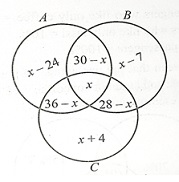
In a city, three daily newspapers A, B, C are published, 42% read A; 51% read B; 68% read C; 30% read A and B; 28% read B and C; 36% read A and C; 8% do not read any of the three newspapers.
Let x% people read all the three newspapers.
Since 8% people do not read any newspapers.
(x – 24) + (x – 7) + (x + 4) + (30 – x) + (36 – x) + (28 – x) + x = 92
→ x + 98 – 31 = 92
→ x = 92 – 67 = 25
What is the percentage of persons who read only two papers?
A
19%
B
31%
C
44%
D
None of these
Question 60Single Answer
Passage :
For the next four : question that follow :
In a city, three daily newspapers A, B, C are published, 42% read A; 51% read B; 68% read C; 30% read A and B; 28% read B and C; 36% read A and C; 8% do not read any of the three newspapers.
Let x% people read all the three newspapers.
Since 8% people do not read any newspapers.
(x – 24) + (x – 7) + (x + 4) + (30 – x) + (36 – x) + (28 – x) + x = 92
→ x + 98 – 31 = 92
→ x = 92 – 67 = 25
What is the percentage of persons who read only one paper ?
A
38%
B
48%
C
51%
D
None of these
Constitution of India, Current Affairs & Comprehension
Question 61Single Answer
I go to Madurai by —– Vaigai Express
A
a
B
an
C
some
D
the
Question 62Single Answer
Have the car stolen!
A
Steal the car
B
You should have the stolen car
C
Get someone to steal the car
D
They have stolen the car
Question 63Single Answer
Passage :
Direction : Question below has two blanks, each blank indicting that some thing has been omitted. Choose the word for each blank which best fits the meaning of the sentence as a whole.
The Finance Department has ……………a centralized online databank system for all statutory government bodies to …………an eye on their assets and liabilities.
A
presented , stay
B
introduced , keep
C
announce , make
D
created , let
E
proclaimed , hold
Question 64Single Answer
Passage :
Direction : The five items in this section consists of a word or group of words followed by four words as (a), (b), (c) and (d). Select the word which is nearly opposite to the meaning of the original word or group of words and mark your response as (a), (b), (c) and (d), as the case may be, in your Answer Sheet.
Assets
A
liabilities
B
responsibilities
C
estates
D
profits
Question 65Single Answer
Passage :
Direction : In the question, out of the four alternatives, choose the word which is opposite in meaning to the given word and click the button corresponding to it
Affidavit
A
Affirmation
B
Slander
C
Oath
D
Testimony
Question 66Single Answer
"શાંતિ" શબ્દનો અર્થ શું છે ?
A
વાતચીત
B
આક્રમણ
C
ખેડૂત
D
ધમાધમ
Question 67Single Answer
"વ્યક્તિ" શબ્દનો વિલોમ શબ્દ શું છે ?
A
સંગઠન
B
વ્યવસ્થા
C
સંવિદાન
D
અનવરત
Question 68Single Answer
"વિકાસ" શબ્દનું અર્થ શું છે ?
A
અભિવૃદ્ધિ
B
વિઘટન
C
વિદ્યા
D
આકર્ષણ
Question 69Single Answer
"સ્થાન" શબ્દનું વિરોધી શબ્દ શું છે ?
A
ધૂપ
B
દૂર
C
જગ્યા
D
આવેશ
Question 70Single Answer
"મંજિલ" શબ્દનો વ્યાપારિક અર્થ શું છે ?
A
ગોલ
B
ધબ્બુ
C
સાંજ
D
ઉદ્દેશ
Question 71Single Answer
Which Act gave separate electorate rights to Muslims in India ?
A
The Indian Councils Act, 1909
B
The Government of India Act, 1915
C
The Government of India Act, 1919
D
The Government of India Act, 1935
Question 72Single Answer
Which one of the following made the Indian Legislature bicameral ?
A
The Indian Councils Act, 1909
B
Government of India Act, 1919
C
Government of India Act, 1935
D
Indian Independence Act, 1947
Question 73Single Answer
'Diarchy' was established in India by which of the following ?
A
The Indian Councils Act, 1909
B
The Government of India Act, 1935
C
The Government of India Act, 1919
D
None of the above
Question 74Single Answer
Which one of the following aimed at providing a federal structure for India ?
A
Indian Councils Act, 1909
B
Government of India Act, 1919
C
Government of India Act, 1935
D
Indian Independence Act, 1947
Question 75Single Answer
As a guardian of the government of India Act, 1935 a Court was constituted which was called.
A
Privy Council
B
Supreme Court
C
High Court
D
Federal Court
Question 76Single Answer
Under the Government of India Act 1935, the Federal court had -
A
Original jurisdiction only
B
Appellate jurisdiction only
C
Advisory jurisdiction only
D
Original, appellate and advisory jurisdiction
Question 77Single Answer
Under the Government of India's Act 1935, how many Governors and Chief Commissioners provinces constituted in British India ?
A
14 and 7
B
11 and 7
C
15 and 9
D
None of the above
Question 78Single Answer
The Mountbaten plan led to the enactment of :
A
Government of India Act, 1919
B
Government of India Act, 1935
C
The Indian Independence Act, 1947
D
None of the above
Question 79Single Answer
The plan of Lord Mountbatten was excepted by the congress and the muslim league. The British Parliament enacted the Indian Independence act, 1947 which got Royal assistant on -
A
3 June, 1947
B
4 July, 1947
C
15 July, 1947
D
18 July, 1947
Question 80Single Answer
Which one of the following relates to transfer of power to the Indians and partition of the country ?
A
Simon Commission
B
Cripps Mission
C
Cabinet Mission Plan
D
The Mountbatten plan
Question 81Single Answer
What major defence-related development was highlighted on 1 May 2026 involving India and Italy?
A
Joint naval exercise in the Indian Ocean
B
Purchase of Rafale jets
C
Rajnath Singh-Italy Defence Pact
D
Signing of a nuclear agreement
Question 82Single Answer
Which satellite was launched by ISRO around early May 2026?
A
GSAT-31
B
Chandrayaan-4
C
INSAT-4CR
D
GSAT-32
Question 83Single Answer
What is Prerna 2.0, launched/introduced in the news on 1 May 2026?
A
A new defence missile system
B
Green hydrogen mission
C
AI Tutoring initiative
D
Digital payment platform
Question 84Single Answer
UAE announced its exit from OPEC, with the decision taking effect from:
A
1 May 2026
B
1 January 2026
C
1 July 2026
D
31 December 2026
Question 85Single Answer
A tragic road accident in Dhar, Madhya Pradesh on or around 1 May 2026 resulted in how many deaths?
A
At least 16 (including 6 children and 7 women)
B
8
C
25
D
12
Question 86Single Answer
A wall collapse at a hospital in which city killed seven people around early May 2026?
A
Bengaluru, Karnataka
B
Mumbai
C
Hyderabad
D
Chennai
Question 87Single Answer
Indian airlines (Air India, IndiGo, SpiceJet) informed the government about potential operational issues due to:
A
Pilot shortage
B
High fuel prices and Strait of Hormuz closure amid Iran war
C
New DGCA regulations
D
Airport congestion
Question 88Single Answer
RBI's April 2026 Monetary Policy kept the repo rate unchanged at:
A
6.5%
B
6.0%
C
4.75%
D
5.25%
Question 89Single Answer
Which initiative or mission was linked to Tatya Tope’s letter discovery?
A
Swachh Bharat
B
Namami Gange
C
Digital India
D
Gyan Bharatam Mission
Question 90Single Answer
Neeraj Chopra began his pre-season training for 2026 in which country?
A
Germany
B
South Africa (Potchefstroom)
C
USA
D
Australia
Technical Subject (Ayurveda)
Question 91Single Answer
Bheshajagara in Ayurveda refers to?
A
Hospital ward
B
Pharmacy or drug manufacturing unit
C
Surgery room
D
Yoga center
Question 92Single Answer
Rasashala is mainly associated with?
A
Patient ward
B
Hospital kitchen
C
Drug manufacturing laboratory
D
Gymnasium
Question 93Single Answer
GMP in Ayurveda stands for?
A
General Medical Practice
B
Good Manufacturing Practices
C
Global Medicine Policy
D
General Manufacturing Protocol
Question 94Single Answer
WHO GMP guidelines are used for?
A
Surgery standards
B
Yoga practices
C
Nursing ethics
D
Pharmaceutical manufacturing quality assurance
Question 95Single Answer
In a pharmacy, production area is used for?
A
Drug storage
B
Patient admission
C
Manufacturing of medicines
D
Record keeping only
Question 96Single Answer
Quality control area is responsible for?
A
Staff recruitment
B
Packaging only
C
Cleaning only
D
Testing and ensuring drug quality
Question 97Single Answer
Weighing area in pharmacy is used for?
A
Drug mixing
B
Storage of finished goods
C
Accurate measurement of raw materials
D
Patient treatment
Question 98Single Answer
Ancillary areas in pharmacy include?
A
Only production halls
B
Supporting areas like washing and utility rooms
C
Surgery rooms
D
Patient wards
Question 99Single Answer
Paricharaka in pharmacy refers to?
A
Doctor
B
Assistant worker
C
Pharmacist owner
D
Patient
Question 100Single Answer
Drug Keeper is responsible for?
A
Surgery
B
Diagnosis
C
Storage and maintenance of drugs
D
Physiotherapy
Question 101Single Answer
Bhaishajya Kalpana mainly deals with?
A
Surgery techniques
B
Diagnosis methods
C
Anatomy study
D
Pharmaceutical preparations in Ayurveda
Question 102Single Answer
Paribhasha in Bhaishajya Kalpana refers to?
A
Measurement units
B
Types of surgery
C
Types of diseases
D
Definitions of concepts
Question 103Single Answer
Mana in Bhaishajya Kalpana refers to?
A
Units of measurement
B
Time measurement
C
Disease classification
D
Drug toxicity
Question 104Single Answer
Panchavidha Kashaya Kalpana includes?
A
Five surgical methods
B
Five herbal formulations
C
Five diagnostic tools
D
Five body tissues
Question 105Single Answer
Anukta dravya grahana means?
A
Taking only mentioned drugs
B
Using toxic drugs only
C
Avoiding all drugs
D
Using unmentioned but similar drugs
Question 106Single Answer
Visheshokta dravya grahana means?
A
Using specifically mentioned drugs
B
Avoiding drugs
C
Mixing all drugs
D
Heating drugs only
Question 107Single Answer
Dravyasthita Rasa refers to?
A
Taste of food only
B
Mineral taste only
C
Blood taste
D
Natural taste present in drugs
Question 108Single Answer
Veerya in Ayurveda refers to?
A
Color of drug
B
Weight of drug
C
Potency of drug
D
Shape of drug
Question 109Single Answer
Vipaka refers to?
A
Taste only
B
Final post-digestive effect
C
Drug color
D
Drug weight
Question 110Single Answer
Prabhava means?
A
General property
B
Specific unique action
C
Toxic effect only
D
Dosage form
Question 111Single Answer
Khalwa Yantra is used for?
A
Grinding and trituration
B
Distillation
C
Heating only
D
Storage
Question 112Single Answer
Arka Yantra is mainly used for?
A
Distillation process
B
Mixing powders
C
Cooling drugs
D
Crushing herbs
Question 113Single Answer
Patana Yantra is used for?
A
Filtration only
B
Storage
C
Distillation/sublimation process
D
Heating food
Question 114Single Answer
Aushadhi dravya storage is mainly done to?
A
Increase toxicity
B
Reduce weight
C
Change taste
D
Preserve potency and quality
Question 115Single Answer
Proper storage of medicines prevents?
A
Increase in potency
B
Faster reaction
C
Better taste
D
Degradation and spoilage
Question 116Single Answer
Nidan in Ayurveda refers to?
A
Treatment
B
Diagnosis only
C
Cause of disease
D
Prognosis
Question 117Single Answer
Panch Nidan mainly includes?
A
Five stages of treatment
B
Five organs
C
Five medicines
D
Five diagnostic factors
Question 118Single Answer
Vyadhi is defined as?
A
Health
B
Disease
C
Medicine
D
Therapy
Question 119Single Answer
Vyadhi classification mainly includes?
A
Acute and chronic
B
Herbal and mineral
C
Internal and external only
D
Saadhya and Asadhya
Question 120Single Answer
Saadhya Vyadhi means?
A
Genetic disease only
B
Incurable disease
C
Fatal disease only
D
Curable disease
Question 121Single Answer
Asaadhya Vyadhi means?
A
Curable disease
B
Seasonal disease
C
Mild disease
D
Incurable disease
Question 122Single Answer
Chikitsa means?
A
Diagnosis
B
Disease cause
C
Treatment
D
Examination
Question 123Single Answer
Chikitsa Chatuspada refers to?
A
Four types of diseases
B
Four stages of disease
C
Four pillars of treatment
D
Four organs
Question 124Single Answer
Chikitsa Chatuspada includes?
A
Doctor, patient, nurse, medicine
B
Vaidya, patient, medicine, attendant
C
Blood, pulse, urine, stool
D
Diet, sleep, exercise, medicine
Question 125Single Answer
Samshodhana Chikitsa means?
A
Purification therapy
B
Suppression therapy
C
Nutritional therapy
D
Surgical therapy only
Question 126Single Answer
Rasashastra is mainly the branch of Ayurveda dealing with?
A
Surgery
B
Metals, minerals and herbo-mineral preparations
C
Anatomy
D
Physiology
Question 127Single Answer
Rasa in Rasashastra generally refers to?
A
Mercury and metallic preparations
B
Taste only
C
Blood
D
Bone
Question 128Single Answer
Maharasa includes substances like?
A
Copper and iron
B
Gold and silver
C
Only herbs
D
Hingula and Gandhaka
Question 129Single Answer
Uparasa in Rasashastra refers to?
A
Subordinate minerals
B
Primary metals
C
Only herbs
D
Only salts
Question 130Single Answer
Saadharan Rasa includes?
A
Only gold
B
Common minerals
C
Only mercury
D
Only plants
Question 131Single Answer
Dhatu in Rasashastra refers to?
A
Tissues of body
B
Waste products
C
Metals
D
Medicines only
Question 132Single Answer
Upadhatu refers to?
A
By-products of dhatus
B
Main metals
C
Only herbs
D
Only minerals
Question 133Single Answer
Shodhana in Rasashastra means?
A
Mixing
B
Purification process
C
Heating only
D
Storage
Question 134Single Answer
Marana refers to?
A
Crushing only
B
Grinding
C
Mixing
D
Incineration/calx formation
Question 135Single Answer
Bhavana in Rasashastra means?
A
Heating
B
Filtering
C
Drying
D
Trituration with liquid media
Question 136Single Answer
Avapa means?
A
Heating process
B
Grinding only
C
Addition of substances during preparation
D
Storage
Question 137Single Answer
Nirvapa refers to?
A
Drying
B
Heating
C
Cooling by quenching
D
Filtering
Question 138Single Answer
Dhanvantari Bhaga refers to?
A
Herbal part
B
Mineral waste
C
Food part
D
Purified fraction in processing
Question 139Single Answer
Rudra Bhaga refers to?
A
Toxic fraction
B
Herbal extract
C
Food part
D
Specific potent fraction in processing
Question 140Single Answer
Damaru Yantra is mainly used for?
A
Cooling
B
Grinding
C
Distillation process
D
Mixing
Question 141Single Answer
Drugs classified on the basis of Bhoutika Sanghatana are based on?
A
Panchamahabhuta composition
B
Taste only
C
Color of drug
D
Price of drug
Question 142Single Answer
Paarthivadi Dravya are classified under?
A
Rasabheda
B
Bhoutika Sanghatana
C
Vipaka
D
Veerya
Question 143Single Answer
Yonibheda classification of drugs is based on?
A
Potency
B
Taste
C
Source of origin
D
Action
Question 144Single Answer
Jangama Dravya are obtained from?
A
Plants
B
Soil only
C
Minerals
D
Animals
Question 145Single Answer
Aoudbhida Dravya are obtained from?
A
Animals
B
Metals
C
Minerals
D
Plants
Question 146Single Answer
Bhouma Dravya are obtained from?
A
Plants
B
Minerals
C
Animals
D
Water only
Question 147Single Answer
Prayoga Bheda classification is based on?
A
Drug color
B
Drug use/application
C
Drug shape
D
Drug smell
Question 148Single Answer
Aushadhi Dravya refers to?
A
Food substances
B
Medicinal drugs
C
Poison only
D
Minerals only
Question 149Single Answer
Ahara Dravya means?
A
Food substances
B
Medicines
C
Minerals
D
Metals
Question 150Single Answer
Rasabheda classification is based on?
A
Shape
B
Weight
C
Color
D
Taste
Question 151Single Answer
Madhuraskanda drugs have?
A
Bitter taste
B
Sweet taste
C
Sour taste
D
Pungent taste
Question 152Single Answer
Amlaskanda refers to?
A
Sweet group
B
Astringent group
C
Bitter group
D
Sour group
Question 153Single Answer
Katu skanda drugs are?
A
Pungent
B
Sweet
C
Bitter
D
Astringent
Question 154Single Answer
Tikta skanda means?
A
Bitter group
B
Sweet group
C
Sour group
D
Salty group
Question 155Single Answer
Kashaya skanda refers to?
A
Sweet group
B
Astringent group
C
Sour group
D
Pungent group
Question 156Single Answer
Dravya in Dravyaguna Vignana refers to?
A
Only property
B
Substances having qualities and actions
C
Only action
D
Only taste
Question 157Single Answer
Dravyaguna Vignana mainly deals with?
A
Surgery
B
Anatomy only
C
Study of medicinal substances and their properties
D
Pathology only
Question 158Single Answer
Panchabhautika Nishpatti means?
A
Formation from seven tissues
B
Formation from blood only
C
Formation from five elements
D
Formation from doshas
Question 159Single Answer
Aushadhatwa of Dravya refers to?
A
Medicinal property
B
Disease causing nature
C
Toxic nature
D
Digestive property
Question 160Single Answer
Guna in Ayurveda means?
A
Substance
B
Disease
C
Quality or attribute
D
Tissue
Question 161Single Answer
Karma in Dravyaguna refers to?
A
Taste
B
Dosha
C
Structure
D
Action of substance
Question 162Single Answer
Rasa means?
A
Tissue
B
Drug
C
Bone
D
Taste
Question 163Single Answer
Veerya indicates?
A
Color
B
Shape
C
Weight
D
Potency of drug
Question 164Single Answer
Vipaka refers to?
A
Shape
B
Taste only
C
Post-digestive effect
D
Dosha
Question 165Single Answer
Prabhava means?
A
General effect
B
Taste
C
Specific unexplained action
D
Dosha imbalance
Question 166Single Answer
Triphala consists of?
A
Musta, Jeera, Ajwain
B
Ginger, Garlic, Pepper
C
Haritaki, Amalaki, Bibhitaki
D
Neem, Tulsi, Aloe
Question 167Single Answer
Trikatu consists of?
A
Ginger, Black pepper, Long pepper
B
Haritaki, Amalaki, Bibhitaki
C
Musta, Pippali, Jeera
D
Garlic, Onion, Ginger
Question 168Single Answer
Laghu Panchamula includes?
A
Small roots group
B
Fruits group
C
Seeds group
D
Leaves group
Question 169Single Answer
Brihat Panchamula includes?
A
Five fruits
B
Five leaves
C
Five big roots
D
Five seeds
Question 170Single Answer
Dashamula consists of?
A
Five herbs
B
Ten flowers
C
Ten fruits
D
Ten roots
Question 171Single Answer
In Ayurveda, Dosha refers to?
A
Functional biological factors governing body
B
Structural elements of body
C
Waste products only
D
Mental states only
Question 172Single Answer
Total number of Doshas in Ayurveda is?
A
Two
B
Three
C
Four
D
Seven
Question 173Single Answer
Vata Dosha is mainly responsible for?
A
Digestion
B
Movement and nervous functions
C
Lubrication
D
Tissue growth only
Question 174Single Answer
Pitta Dosha primarily governs?
A
Metabolism and digestion
B
Stability
C
Movement
D
Bone formation
Question 175Single Answer
Kapha Dosha mainly provides?
A
Heat
B
Transformation
C
Movement
D
Stability and lubrication
Question 176Single Answer
In Ayurveda, Sharira refers to?
A
Only mind
B
Disease condition
C
Soul only
D
Physical body
Question 177Single Answer
Shaarira mainly denotes?
A
Mental state
B
Toxicology
C
Surgery only
D
Study of body structure
Question 178Single Answer
Garbha Sharira refers to?
A
Study of disease
B
Embryology and fetal development
C
Adult anatomy
D
Bone study
Question 179Single Answer
Garbhotpatti means?
A
Death process
B
Digestion process
C
Formation of embryo
D
Blood formation
Question 180Single Answer
According to Ayurveda, human body is composed of?
A
Only five elements
B
Only tissues
C
Panchamahabhutas
D
Only organs
Question 181Single Answer
Swasthavritta mainly deals with?
A
Surgery
B
Preventive healthcare and healthy lifestyle
C
Toxicology
D
Pediatrics
Question 182Single Answer
The term “Swastha” means?
A
Diseased person
B
Old age
C
Child only
D
Healthy person
Question 183Single Answer
Dinacharya refers to?
A
Seasonal regimen
B
Surgical regimen
C
Daily regimen
D
Mental therapy
Question 184Single Answer
Ritucharya means?
A
Seasonal regimen
B
Conduct during disease
C
Daily routine
D
Night regimen
Question 185Single Answer
Brahma Muhurta is the ideal time for?
A
Sleeping
B
Bathing
C
Eating
D
Awakening
Question 186Single Answer
Dantadhavana means?
A
Eye washing
B
Tongue cleaning
C
Brushing teeth
D
Oil massage
Question 187Single Answer
Jivha Nirlekhana refers to?
A
Ear cleaning
B
Nasal therapy
C
Bathing
D
Tongue scraping
Question 188Single Answer
Gandusha is?
A
Eye treatment
B
Ear therapy
C
Nasal cleansing
D
Holding medicated liquid in mouth
Question 189Single Answer
Anjana is mainly used for?
A
Ear disorders
B
Dental care
C
Eye care
D
Hair care
Question 190Single Answer
Nasya therapy is administered through?
A
Mouth
B
Eyes
C
Nose
D
Ears
Question 191Single Answer
According to Ayurveda, Ayu is defined as?
A
Combination of body only
B
State of happiness only
C
Function of mind only
D
Union of body, senses, mind and soul
Question 192Single Answer
Which of the following is a synonym of Ayu?
A
Sharira
B
Jeevita
C
Agni
D
Dosha
Question 193Single Answer
Hitayu refers to?
A
Beneficial and healthy life
B
Happy life
C
Unhealthy life
D
Painful life
Question 194Single Answer
Ahitayu means?
A
Harmful and unhealthy life
B
Beneficial life
C
Long life
D
Spiritual life
Question 195Single Answer
Sukhayu is characterized by?
A
Miserable living
B
Disease condition
C
Healthy and happy life
D
Lack of discipline
Question 196Single Answer
Dukhayu indicates?
A
Comfortable life
B
Wealthy life
C
Sorrowful and unhealthy life
D
Spiritual liberation
Question 197Single Answer
The word Ayurveda is composed of?
A
Agni + Veda
B
Ayu + Veda
C
Mana + Veda
D
Dosha + Veda
Question 198Single Answer
Ayurveda primarily deals with?
A
Science of life
B
Metallurgy
C
Astronomy
D
Agriculture
Question 199Single Answer
The main prayojana of Ayurveda is?
A
Wealth generation
B
Social management
C
Political success
D
Protection of health and cure of disease
Question 200Single Answer
“Swasthasya Swasthya Rakshanam” means?
A
Cure of all diseases
B
Promotion of trade
C
Study of surgery
D
Protection of health of healthy person
Question 201Single Answer
“Aturasya Vikara Prashamanam” refers to?
A
Prevention of epidemic
B
Preservation of food
C
Curing disease in diseased person
D
Physical exercise
Question 202Single Answer
Trisutra Ayurveda consists of?
A
Dosha, Dhatu, Mala
B
Hetu, Linga, Aushadha
C
Vata, Pitta, Kapha
D
Agni, Ama, Ojas
Question 203Single Answer
In Trisutra Ayurveda, Hetu means?
A
Symptom
B
Treatment
C
Prognosis
D
Cause of disease
Question 204Single Answer
In Trisutra Ayurveda, Linga indicates?
A
Cause
B
Diet
C
Medicine
D
Sign and symptom
Question 205Single Answer
Aushadha in Trisutra Ayurveda refers to?
A
Treatment or medicine
B
Surgery
C
Disease
D
Diagnosis
Question 206Single Answer
Which Acharya described Trisutra Ayurveda prominently?


 5.015 =?