📚 Exam by Category
▾
Objective Questions

Latest GATE Instrumentation Engineering Exam Question (Objective Questions), MCQ in English

Subjects : General Aptitude, Engineering Mathematics, Instrumentation Engineering

Question Bank GATE Instrumentation Engineering Exam (Only MCQ ) - English

Back to Exam

General Aptitude

Question 1Single Answer
Inhaling the smoke from a burning _____ could _____ you quickly.
  1. A
    tire/tier
  2. B
    tire/tyre
  3. C
    tyre/tire
  4. D
    tyre/tier
Question 2Single Answer
The cost price of 20 articles is the same as the selling price of x articles. If the profit is 25%, then the value of x is :
  1. A
    15
  2. B
    16
  3. C
    18
  4. D
    25
Question 3Single Answer
Pipes P and Q can fill a storage tank full of water in 10 and 6 minutes, respectively. Pipe R draws the water out from the storage tank at a rate of 34 litres per minute. P, Q and R operate at a constant rate. If it takes one hour to completely empty a full storage tank with all the pipes operating simultaneously, what is the capacity of the storage tank (in litres) ? 
  1. A
    26.8 
  2. B
    60.0 
  3. C
    120.0
  4. D
    127.5
Question 4Single Answer
Choose the grammatically correct sentence?
  1. A
    Neither of the robots are functioning properly
  2. B
    Neither robots is functioning properly
  3. C
    Neither of the robot are functioning properly
  4. D
    Neither of the robots is functioning properly
Question 5Single Answer
Choose the correct form to complete the sentence: “By the time the engineer arrived, the robotic arm _____ its assigned operation”?
  1. A
    completes
  2. B
    has completed
  3. C
    had completed
  4. D
    was complete

Engineering Mathematics

Question 6Single Answer
Consider the following expression :
where z, y, and t are variables, and   is a complex number. The partial differential equation derived from the above expression is
  1. A
  2. B
  3. C
  4. D
Question 7Single Answer
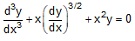
For the equation
the correct description is
  1. A
    an ordinary differential equation of order 3 and degree 2 
  2. B
    an ordinary differential equation of order 3 and degree 3 
  3. C
    an ordinary differential equation of order 2 and degree 3 
  4. D
    an ordinary differential equation of order 3 and degree 
Question 8Single Answer
The value of (1 + i)12, where  , is.
  1. A
    – 64 i 
  2. B
    64 i
  3. C
    64 
  4. D
    – 64
Question 9Single Answer
If (A=\begin{bmatrix}1&2\3&4\end{bmatrix}), what is (\det(A))?
  1. A
    2
  2. B
    (-2)
  3. C
    5
  4. D
    10
Question 10Single Answer
If (A) is a (3\times3) matrix with (\det(A)=5), what is (\det(2A))?
  1. A
    10
  2. B
    40
  3. C
    20
  4. D
    80

Instrumentation Engineering

Question 11Single Answer
According to Coulomb’s law, the electrostatic force between two point charges is proportional to which quantity?
  1. A
    Sum of the charges
  2. B
    Product of the charges
  3. C
    Difference of the charges
  4. D
    Square root of the charges
Question 12Single Answer
The electrostatic force between two point charges varies with their separation (r) as which relation?
  1. A
    (1/r^2)
  2. B
    (1/r)
  3. C
    (r)
  4. D
    (r^2)
Question 13Single Answer
What is the SI unit of electric field intensity?
  1. A
    C/m
  2. B
    V·m
  3. C
    V/m
  4. D
    C·m
Question 14Single Answer
What is the SI unit of electric flux density (D)?
  1. A
    C/m
  2. B
    V/m
  3. C
    C/m²
  4. D
    N/C²
Question 15Single Answer
Electric field intensity (E) and electric flux density (d) in a linear isotropic medium are related by which expression?
  1. A
    (D=\mu E)
  2. B
    (D=\sigma E)
  3. C
    (D=\epsilon E)
  4. D
    (D=E/\epsilon)
Question 16Single Answer
What is the permittivity of free space approximately equal to?
  1. A
    (8.854\times10^{-12}) F/m
  2. B
    (1.257\times10^{-6}) F/m
  3. C
    (9\times10^9) F/m
  4. D
    (1.602\times10^{-19}) F/m
Question 17Single Answer
What is the value of Coulomb’s constant (1/(4\pi\epsilon_0)) approximately?
  1. A
    (1.26\times10^{-6}) N·m²/C²
  2. B
    (8.85\times10^{-12}) N·m²/C²
  3. C
    (8.99\times10^9) N·m²/C²
  4. D
    (3\times10^8) N·m²/C²
Question 18Single Answer
Two identical positive point charges are placed near each other. What is the direction of force between them?
  1. A
    Repulsive along their joining line
  2. B
    Attractive along their joining line
  3. C
    Perpendicular to their joining line
  4. D
    Tangential to a circle through them
Question 19Single Answer
Two point charges of opposite signs are placed near each other. What type of electrostatic force acts between them?
  1. A
    Repulsive force
  2. B
    Tangential force
  3. C
    Attractive force
  4. D
    Zero force
Question 20Single Answer
If the separation between two point charges is doubled, what happens to the Coulomb force?
  1. A
    It becomes half
  2. B
    It becomes twice
  3. C
    It becomes one-fourth
  4. D
    It becomes four times
Question 21Single Answer
If both point charges are doubled while their separation remains unchanged, what happens to the electrostatic force?
  1. A
    It doubles
  2. B
    It quadruples
  3. C
    It triples
  4. D
    It remains unchanged
Question 22Single Answer
Electric field intensity at a point is defined as which quantity?
  1. A
    Charge per unit surface area
  2. B
    Energy per unit positive test charge
  3. C
    Force per unit positive test charge
  4. D
    Flux per unit volume
Question 23Single Answer
What is the electric field produced by an isolated positive point charge directed toward?
  1. A
    Radially inward
  2. B
    Radially outward
  3. C
    Circumferentially clockwise
  4. D
    Circumferentially anticlockwise
Question 24Single Answer
What is the electric field produced by an isolated negative point charge directed toward?
  1. A
    Tangentially outward
  2. B
    Radially outward
  3. C
    Radially inward
  4. D
    Normally away from the charge
Question 25Single Answer
What is the magnitude of electric field at distance (r) from a point charge (Q) in free space?
  1. A
    (Q/(4\pi\epsilon_0r))
  2. B
    (Q/(2\pi\epsilon_0r))
  3. C
    (Q/(4\pi\epsilon_0r^2))
  4. D
    (Q/(2\pi\epsilon_0r^2))
Question 26Single Answer
The principle of superposition for electric fields states that the resultant field equals which quantity?
  1. A
    Vector sum of individual fields
  2. B
    Scalar product of individual fields
  3. C
    Average of individual fields
  4. D
    Maximum individual field
Question 27Single Answer
What is the electric potential at distance (r) from an isolated point charge (Q) in free space, taking zero potential at infinity?
  1. A
    (Q/(4\pi\epsilon_0r))
  2. B
    (Q/(4\pi\epsilon_0r^2))
  3. C
    (Qr/(4\pi\epsilon_0))
  4. D
    (Qr^2/(4\pi\epsilon_0))
Question 28Single Answer
What is the SI unit of electric potential?
  1. A
    Ampere
  2. B
    Weber
  3. C
    Tesla
  4. D
    Volt
Question 29Single Answer
Electric field intensity is related to electric potential by which expression?
  1. A
    (E=\nabla V)
  2. B
    (E=\nabla\times V)
  3. C
    (E=-\nabla V)
  4. D
    (E=-\nabla\times V)
Question 30Single Answer
What is the work done in moving a charge along an equipotential surface in an electrostatic field?
  1. A
    Maximum
  2. B
    Minimum but nonzero
  3. C
    Zero
  4. D
    Infinite
Question 31Single Answer
Electric field lines intersect equipotential surfaces at what angle?
  1. A
    (0^\circ)
  2. D
    (30^\cir
Question 32Single Answer
What is the electric field inside a conductor under electrostatic equilibrium?
  1. A
    Uniform and finite
  2. B
    Proportional to conductivity
  3. C
    Infinite
  4. D
    Zero
Question 33Single Answer
Under electrostatic equilibrium, excess charge on an isolated conductor resides where?
  1. A
    At its center
  2. B
    Throughout its volume uniformly
  3. C
    On its surface
  4. D
    Only at its lowest point
Question 34Single Answer
The potential throughout a conductor in electrostatic equilibrium has what characteristic?
  1. A
    It varies quadratically
  2. B
    It varies linearly
  3. C
    It is constant
  4. D
    It is always zero
Question 35Single Answer
Gauss’s law states that the total electric flux through a closed surface equals which quantity?
  1. A
    Enclosed charge divided by permittivity
  2. B
    Enclosed charge multiplied by permittivity
  3. C
    Surface charge multiplied by area
  4. D
    Electric potential divided by permittivity
Question 36Single Answer
Which mathematical expression represents Gauss’s law in integral form using (D)?
  1. A
    (\oint_S D\cdot dl=Q_{\text{enc}})
  2. B
    (\oint_S D\times dS=Q_{\text{enc}})
  3. C
    (\oint_S D\cdot dS=Q_{\text{enc}})
  4. D
    (\oint_S D\times dl=Q_{\text{enc}})
Question 37Single Answer
Which differential equation represents Gauss’s law?
  1. A
    (\nabla\times D=\rho_v)
  2. B
    (\nabla^2D=\rho_v)
  3. C
    (\nabla D=\rho_v^2)
  4. D
    (\nabla\cdot D=\rho_v)
Question 38Single Answer
What does the divergence of electric flux density (d) represent?
  1. A
    Volume charge density
  2. B
    Surface charge density
  3. C
    Line charge density
  4. D
    Electric potential
Question 39Single Answer
What is the SI unit of volume charge density?
  1. A
    C/m
  2. B
    C/m²
  3. C
    C·m
  4. D
    C/m³
Question 40Single Answer
What is the SI unit of surface charge density?
  1. A
    C/m
  2. B
    C·m²
  3. C
    C/m³
  4. D
    C/m²
Question 41Single Answer
What is the SI unit of line charge density?
  1. A
    C/m²
  2. B
    C/m
  3. C
    C/m³
  4. D
    C·m
Question 42Single Answer
The electric field due to an infinitely long line charge varies with radial distance (\rho) according to which relation?
  1. A
    (1/\rho^2)
  2. B
    (1/\rho)
  3. C
    (\rho)
  4. D
    (\rho^2)
Question 43Single Answer
What is the electric field magnitude at distance (\rho) from an infinite line charge of density (\lambd
  1. D
    in a medium of permittivity (\epsilon)?
Question 44Single Answer
What is the magnitude of electric field produced by an infinite sheet carrying uniform surface charge density (\rho_s) in a homogeneous medium?
  1. A
    (\rho_s/\epsilon)
  2. B
    (2\rho_s/\epsilon)
  3. C
    (\rho_s/(4\epsilon))
  4. D
    (\rho_s/(2\epsilon))
Question 45Single Answer
How does the electric field magnitude due to an infinite uniformly charged plane vary with perpendicular distance?
  1. A
    It decreases as (1/r)
  2. B
    It decreases as (1/r^2)
  3. C
    It remains constant
  4. D
    It increases linearly
Question 46Single Answer
Two infinite parallel sheets have equal and opposite surface charge densities. What is the electric field outside the two-sheet system?
  1. A
    (\rho_s/\epsilon)
  2. B
    Zero
  3. C
    (\rho_s/(2\epsilon))
  4. D
    (2\rho_s/\epsilon)
Question 47Single Answer
What is the electric field between two infinite oppositely charged sheets having surface charge densities (+\rho_s) and (-\rho_s)?
  1. A
    (\rho_s/(2\epsilon))
  2. B
    (\rho_s/\epsilon)
  3. C
    (\rho_s/(4\epsilon))
  4. D
    (2\rho_s/\epsilon)
Question 48Single Answer
What is the electric field inside a uniformly charged thin spherical shell?
  1. A
    Zero
  2. B
    Constant and nonzero
  3. C
    Proportional to radius
  4. D
    Inversely proportional to radius
Question 49Single Answer
Outside a uniformly charged spherical shell, its electric field is equivalent to that produced by which charge distribution?
  1. A
    A ring charge along its equator
  2. B
    A line charge along its diameter
  3. C
    A plane charge through its center
  4. D
    A point charge of equal total charge at its center
Question 50Single Answer
Inside a uniformly charged solid sphere, how does electric field magnitude vary with distance (r) from the center?
  1. A
    As (1/r)
  2. B
    As (1/r^2)
  3. C
    Linearly with (r)
  4. D
    Independently of (r)
Important Questions Package

GATE Instrumentation Engineering Exam Online Question Bank Package

Buy GATE Instrumentation Engineering Important Questions, MCQ, question answer in Hindi & English. It will help you to score high marks in GATE Instrumentation Engineering question bank 2026 in Online, PDF & Print study material.

+ Free Monthly Current Affairs, GK & more PDF Download
Sr.Package NameAmount
1.GATE Instrumentation Engineering Exam (Only MCQ ) - English
Description : 1000 Question With Answer
₹101 [₹500]
2.GATE Instrumentation Engineering Exam (Only MCQ ) - English
Description : 2000 Question With Answer
₹151 [₹500]
3.GATE Instrumentation Engineering Exam (Only MCQ ) - English
Description : 3000 Question With Answer
₹181 [₹500]
4.GATE Instrumentation Engineering Exam (Only MCQ ) - English
Description : 4500 Question With Answer
₹221 [₹500]
5.GATE Instrumentation Engineering Exam (Only MCQ ) Question Bank Book - English
Description : 1000 Question with Answer (Printed Material)
₹390 [₹650]
6.GATE Instrumentation Engineering Exam (Only MCQ ) - English
Description : 1000 Question & Answer Download in PDF (Send by Email)
₹151 [₹550]
7.GATE Mining Engineering Exam (Only MCQ)- English
Description : 4000 Question With Answer
₹191 [₹500]
Back to Exam