πŸ“š Exam by Category
β–Ύ
Objective Questions

Latest GATE Civil Engineering Exam Question (Objective Questions), MCQ in English

Subjects : General Aptitude, Engineering Mathematics, Civil Engineering

Question Bank GATE Civil Engineering Exam (Only MCQ ) - English

Back to Exam

General Aptitude

Question 1Single Answer
The cost price of 20 articles is the same as the selling price of x articles. If the profit is 25%, then the value of x is :
  1. A
    15
  2. B
    16
  3. C
    18
  4. D
    25
Question 2Single Answer
Pipes P and Q can fill a storage tank full of water in 10 and 6 minutes, respectively. Pipe R draws the water out from the storage tank at a rate of 34 litres per minute. P, Q and R operate at a constant rate. If it takes one hour to completely empty a full storage tank with all the pipes operating simultaneously, what is the capacity of the storage tank (in litres) ?Β 
  1. A
    26.8Β 
  2. B
    60.0Β 
  3. C
    120.0
  4. D
    127.5
Question 3Single Answer
Choose the grammatically correct sentence?
  1. A
    Neither of the robots are functioning properly
  2. B
    Neither robots is functioning properly
  3. C
    Neither of the robot are functioning properly
  4. D
    Neither of the robots is functioning properly
Question 4Single Answer
Choose the correct form to complete the sentence: β€œBy the time the engineer arrived, the robotic arm _____ its assigned operation”?
  1. A
    completes
  2. B
    has completed
  3. C
    had completed
  4. D
    was complete
Question 5Single Answer
Which article correctly completes the sentence: β€œThe laboratory purchased _____ autonomous mobile robot for navigation experiments”?
  1. A
    a
  2. B
    an
  3. C
    the an
  4. D
    no article

Engineering Mathematics

Question 6Single Answer
Consider the following expression :
where z, y, and t are variables, andΒ  Β is a complex number. The partial differential equation derived from the above expression is
  1. A
  2. B
  3. C
  4. D
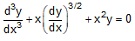
Question 7Single Answer
For the equation
the correct description is
  1. A
    an ordinary differential equation of order 3 and degree 2Β 
  2. B
    an ordinary differential equation of order 3 and degree 3Β 
  3. C
    an ordinary differential equation of order 2 and degree 3Β 
  4. D
    an ordinary differential equation of order 3 and degreeΒ 
Question 8Single Answer
If (A=\begin{bmatrix}1&2\3&4\end{bmatrix}), what is (\det(A))?
  1. A
    2
  2. B
    (-2)
  3. C
    5
  4. D
    10
Question 9Single Answer
If (A) is a (3\times3) matrix with (\det(A)=5), what is (\det(2A))?
  1. A
    10
  2. B
    40
  3. C
    20
  4. D
    80
Question 10Single Answer
In Gaussian elimination, the main purpose of partial pivoting is to?
  1. A
    reduce round-off error and avoid division by a very small pivot
  2. B
    guarantee integer solutions
  3. C
    make the coefficient matrix symmetric
  4. D
    convert every matrix into a diagonal matrix

Civil Engineering

Question 11Single Answer
A free-body diagram of a body should show which of the following?
  1. A
    Only internal forces
  2. B
    Only applied moments
  3. C
    Only support reactions
  4. D
    All external forces and moments acting on the isolated body
Question 12Single Answer
Two forces are said to be concurrent when their lines of action:
  1. A
    Are parallel
  2. B
    Intersect at a common point
  3. C
    Are perpendicular
  4. D
    Lie in different planes
Question 13Single Answer
A couple consists of:
  1. A
    Two equal forces acting in the same direction
  2. B
    Two equal and opposite parallel forces separated by a distance
  3. C
    Two unequal parallel forces
  4. D
    Three concurrent forces
Question 14Single Answer
The resultant force of a pure couple is:
  1. A
    Zero
  2. B
    Maximum
  3. C
    Equal to one of the forces
  4. D
    Dependent on the origin
Question 15Single Answer
The moment of a couple is:
  1. A
    Dependent on the point about which it is taken
  2. B
    Independent of the reference point
  3. C
    Always zero
  4. D
    Equal to the resultant force
Question 16Single Answer
A particle is in equilibrium when:
  1. A
    Its velocity is zero only
  2. B
    The resultant force acting on it is zero
  3. C
    Its acceleration is constant
  4. D
    Its kinetic energy is maximum
Question 17Single Answer
For a rigid body in planar equilibrium, equilibrium requires:
  1. A
    Force and moment balance
  2. B
    Moment balance only
  3. C
    Force balance only
  4. D
    Energy balance only
Question 18Single Answer
A roller support in a two-dimensional idealization usually provides:
  1. A
    One reaction force
  2. B
    Two reaction forces
  3. C
    Two forces and one moment
  4. D
    One reaction moment only
Question 19Single Answer
A pin support in a two-dimensional structure generally develops:
  1. A
    One force only
  2. B
    One force and one moment
  3. C
    Two mutually perpendicular reaction components
  4. D
    One moment only
Question 20Single Answer
A fixed support in a plane structure can resist:
  1. A
    Horizontal force only
  2. B
    Vertical force only
  3. C
    Translation in two directions and rotation
  4. D
    Translation but not rotation
Question 21Single Answer
Friction acts:
  1. A
    Normal to the contact surface
  2. B
    Always vertically downward
  3. C
    Opposite to the tendency of relative motion
  4. D
    Along the resultant reaction only
Question 22Single Answer
Limiting friction refers to friction:
  1. A
    When surfaces are separated
  2. B
    During free fall
  3. C
    At the verge of relative motion
  4. D
    When no normal reaction exists
Question 23Single Answer
Static friction is generally:
  1. A
    Always at its limiting value
  2. B
    Independent of normal reaction
  3. C
    Self-adjusting up to a limiting value
  4. D
    Greater than any possible applied force
Question 24Single Answer
The angle of friction is related to:
  1. A
    Elastic deformation
  2. B
    Moment of inertia
  3. C
    Centrifugal force
  4. D
    Limiting friction and normal reaction
Question 25Single Answer
The angle of repose is the inclination at which a body:
  1. A
    Is just about to slide
  2. B
    Accelerates upward
  3. C
    Loses all contact
  4. D
    Becomes weightless
Question 26Single Answer
For dry friction, the coefficient of friction primarily represents:
  1. A
    Surface resistance to sliding
  2. B
    Material density
  3. C
    Elastic modulus
  4. D
    Moment resistance
Question 27Single Answer
The centroid of a homogeneous body coincides with its center of gravity when:
  1. A
    The body is accelerating
  2. B
    Gravity is uniform
  3. C
    The body is hollow
  4. D
    Friction is absent
Question 28Single Answer
The center of gravity of a body is the point through which:
  1. A
    Internal stress acts
  2. B
    Resultant gravitational force acts
  3. C
    Friction always acts
  4. D
    Acceleration is always zero
Question 29Single Answer
A force may be moved along its line of action without changing its external effect on a rigid body. This is known as:
  1. A
    D'Alembert's principle
  2. B
    Principle of transmissibility
  3. C
    Principle of virtual work
  4. D
    Parallel-axis theorem
Question 30Single Answer
Varignon's theorem states that the moment of a resultant about a point equals:
  1. A
    Zero
  2. B
    The average moment of all forces
  3. C
    The product of all forces
  4. D
    The sum of moments of its component forces about that point
Question 31Single Answer
The resultant of two parallel forces acting in the same direction is:
  1. A
    Their sum acting parallel to them
  2. B
    Their difference
  3. C
    Always zero
  4. D
    A pure couple
Question 32Single Answer
Two equal and opposite collinear forces form:
  1. A
    A couple
  2. B
    A non-zero resultant force
  3. C
    A resultant moment only
  4. D
    An equilibrium force system
Question 33Single Answer
A three-force rigid body in equilibrium, when the forces are non-parallel, must have forces whose lines of action are:
  1. A
    Random
  2. B
    Concurrent
  3. C
    Skew
  4. D
    Circular
Question 34Single Answer
A two-force member in equilibrium carries forces that are:
  1. A
    Equal and parallel but non-collinear
  2. B
    Unequal and perpendicular
  3. C
    Equal, opposite and collinear
  4. D
    Arbitrarily directed
Question 35Single Answer
A member subjected only to forces at its two ends is ideally classified as:
  1. A
    Two-force member
  2. B
    Multi-force member
  3. C
    Couple member
  4. D
    Fixed body
Question 36Single Answer
Newton's first law is fundamentally associated with:
  1. A
    Inertia
  2. B
    Conservation of energy
  3. C
    Impulse
  4. D
    Friction
Question 37Single Answer
Newton's second law relates resultant force to:
  1. A
    Displacement only
  2. B
    Potential energy only
  3. C
    Rate of change of momentum
  4. D
    Angular displacement only
Question 38Single Answer
Newton's third law states that action and reaction:
  1. A
    Are equal and opposite and act on different bodies
  2. B
    Act on the same body
  3. C
    Always cancel in a free-body diagram of one body
  4. D
    Are unrelated
Question 39Single Answer
Kinematics deals with:
  1. A
    Forces causing motion only
  2. B
    Motion without considering its causes
  3. C
    Material strength
  4. D
    Structural stability
Question 40Single Answer
Kinetics deals with:
  1. A
    Geometry of motion only
  2. B
    Material deformation only
  3. C
    Static equilibrium only
  4. D
    Relationship between motion and forces causing it
Question 41Single Answer
Rectilinear motion means motion:
  1. A
    Along a circular path
  2. B
    On a parabolic path only
  3. C
    About a fixed axis only
  4. D
    Along a straight line
Question 42Single Answer
In uniform rectilinear motion, the acceleration is:
  1. A
    Zero
  2. B
    Decreasing
  3. C
    Increasing
  4. D
    Infinite
Question 43Single Answer
During uniform circular motion, the velocity:
  1. A
    Is constant as a vector
  2. B
    Changes direction continuously
  3. C
    Is always zero
  4. D
    Has changing magnitude only
Question 44Single Answer
Centripetal acceleration is directed:
  1. A
    Toward the center of curvature
  2. B
    Tangentially outward
  3. C
    Along the velocity vector
  4. D
    Vertically downward in every case
Question 45Single Answer
Tangential acceleration is associated with change in:
  1. A
    Direction of velocity only
  2. B
    Mass
  3. C
    Magnitude of velocity
  4. D
    Radius only
Question 46Single Answer
In pure translation of a rigid body, all points have:
  1. A
    The same velocity at a given instant
  2. B
    Equal angular velocity but different linear velocity
  3. C
    Different accelerations in every case
  4. D
    Zero displacement
Question 47Single Answer
In pure rotation about a fixed axis, points of a rigid body:
  1. A
    Move along straight parallel paths
  2. B
    Move along circular paths centered on the axis
  3. C
    Remain stationary
  4. D
    Have identical linear velocities
Question 48Single Answer
General plane motion of a rigid body may be regarded as:
  1. A
    Translation only
  2. B
    Rotation only
  3. C
    Combination of translation and rotation
  4. D
    Vibration only
Question 49Single Answer
The instantaneous center of zero velocity is a point that:
  1. A
    Has maximum acceleration
  2. B
    Must lie inside the body
  3. C
    Has zero angular acceleration always
  4. D
    Has zero velocity at the instant considered
Question 50Single Answer
The instantaneous center method is particularly useful for determining:
  1. A
    Velocities in planar rigid-body motion
  2. B
    Material strength
  3. C
    Friction coefficients experimentally
  4. D
    Section properties
Important Questions Package

GATE Civil Engineering Exam Online Question Bank Package

Buy GATE Civil Engineering Important Questions, MCQ, question answer in Hindi & English. It will help you to score high marks in GATE Civil Engineering question bank 2026 in Online, PDF & Print study material.

+ Free Monthly Current Affairs, GK & more PDF Download
Sr.Package NameAmount
1.GATE Civil Engineering Exam (Only MCQ ) - English
Description : 1000 Question With Answer
β‚Ή101 [β‚Ή500]
2.GATE Civil Engineering Exam (Only MCQ ) - English
Description : 2000 Question With Answer
β‚Ή151 [β‚Ή500]
3.GATE Civil Engineering Exam (Only MCQ ) - English
Description : 3000 Question With Answer
β‚Ή171 [β‚Ή500]
4.GATE Civil Engineering Exam (Only MCQ ) - English
Description : 4000 Question With Answer
β‚Ή191 [β‚Ή500]
5.GATE Civil Engineering Exam (Only MCQ ) - English
Description : 1000 Question & Answer Download in PDF (Send by Email)
β‚Ή151 [β‚Ή550]
6.GATE Civil Engineering Exam (Only MCQ ) Question Bank Book - English
Description : 1000 Question with Answer (Printed Material)
β‚Ή390 [β‚Ή650]
Back to Exam
Question for GATE Civil Engineering 2027 - Quiz / Questions / MCQ - Toppersexam